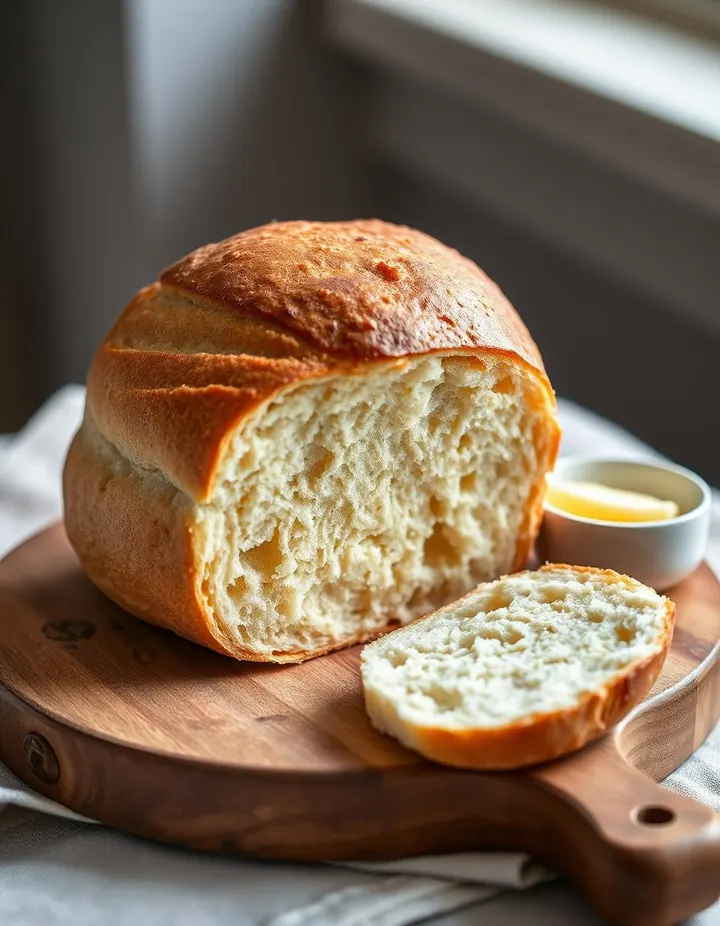
Cottage Bread
Ingredients
Directions
The book says “a quick oven”. The 400°F (200°C) in the steps is the modern equivalent, not the book's own figure.
Make the dough
Combine 14 pounds of flour in a large pan.
Mix 1 quart of warm water with ¼ pint of yeast in a bowl.
Make a hole in the flour. Pour in the water and yeast mixture.
Stir until it forms a thick paste.
Sprinkle a little flour over the mixture.
Let it rise in a warm place for about 1 hour.
Add more warm water and 3 teaspoons of salt.
Knead the dough until it is stiff.
Shape and bake
Cover with a cloth and let it rest for 1 hour.
Divide the dough into loaves.
Bake at 400°F (200°C) for 1 hour and 15 minutes.
Transcribed from a scanned cookbook and modernised for today's kitchens. Where the book gave no heat or time, or said "a moderate oven", the temperatures and times here may be modern equivalents rather than the book's own figures.
Photo for illustrative purposes only · Contact us to use it
Explore the science
What each ingredient does
- Flour
- Forms the structure of the dough, with gluten building as it is kneaded.
- Yeast
- Ferments the dough, producing gas that makes it rise.
- Warm water
- Hydrates the flour and activates the yeast, forming the dough.
- Salt
- Controls yeast activity and adds flavor to the bread.
The step that matters
Let it rise in a warm place. Yeast needs warmth to ferment well. Too cold and the dough rises slowly. Too hot and the yeast can die, leaving the bread dense.
“What each ingredient does” and “The step that matters” were written by Claude from this recipe’s own method and reviewed in samples by CompKitchen.
You might also like
 Cornbread345 recipes
 Bread Pudding336 recipes
 Milk Bread Rolls242 recipes
 Potato Bread124 recipes
The free Flavor Lab newsletter: one surprising pairing a week and the molecular reason it works, in 60 seconds. No spam, unsubscribe anytime.
Prefer an account? Create a free account to save pairings and unlock the full chemistry.