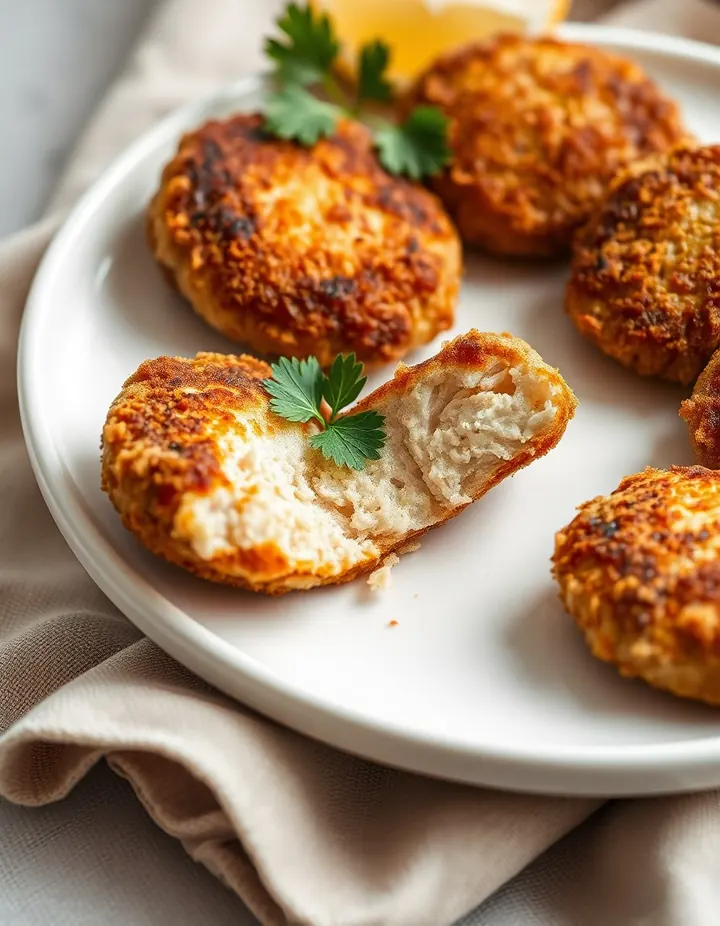
Why it works: Lemon and pepper match in chemistry and in kitchens. They rank in the top 3% of all ingredient pairs, and cooks put them together in 27,047 recipes. Both carry trans-2-nonenal, which smells cardboard, fatty. The science ↓
Chicken Patties
Ingredients
Directions
The book says “a quick oven”. The 400°F (200°C) in the steps is the modern equivalent, not the book's own figure.
Make the filling
Remove the skin from the chicken and chop it finely.
In a saucepan, combine the chicken, ham, gravy (or water), lemon peel, mace or nutmeg, and seasonings. Heat the mixture until hot.
Stir in the flour mixed with butter. Let the mixture simmer for a few minutes.
Remove the mixture from heat and add the sweet cream.
Line and bake
Line patty pans with puff pastry and brush the edges with melted butter.
Place a piece of bread in each patty pan. Cover the bread with a thin layer of pastry.
Bake the patties at 400°F (200°C).
Fill and serve
Once baked, remove the top crust. Take out the bread.
Fill the pastry with the chicken mixture. Return the patties to the oven for a moment.
Serve.
Transcribed from a scanned cookbook and modernised for today's kitchens. Where the book gave no heat or time, or said "a moderate oven", the temperatures and times here may be modern equivalents rather than the book's own figures.
Photo for illustrative purposes only · Contact us to use it
Explore the science
The flavor team
The pairs that carry this dish. Each one is judged two ways: how much their aromas overlap, and how often cooks already put them together.
-
Lemon + peppertop 3% of all pairsSmell alikestrongCooked together27,047 recipes
Shared aroma: trans-2-nonenal (cardboard, fatty).
-
Mace + white peppertop 9% of all pairsSmell alikemoderateCooked together1,695 recipes
Shared aroma: myrcene (balsamic, herbaceous).
-
Flour + buttertop 12% of all pairsSmell alikelowCooked together124,287 recipes
Shared aroma: isobutyraldehyde (malty, green).
-
Chicken + hamtop 14% of all pairsSmell alikemoderateCooked together1,497 recipes
Shared aroma: 1-octen-3-ol (mushroom, earthy).
-
Chicken + buttertop 15% of all pairsSmell alikemoderateCooked together13,902 recipes
Shared aroma: 2-furfurylthiol (coffee, roasted).
Flour and butter barely smell alike, yet cooks put them together in 124,287 recipes: they work on texture and structure more than aroma.
Ranks compare each pair with 20,000 random ingredient pairs on CompKitchen. How we score pairs
What each ingredient does
- Chicken
- Forms the bulk of the filling, giving the patties their main substance and meaty texture.
- Flour
- Mixed with butter and simmered, it thickens the filling so it holds together in the pastry.
- Butter
- Enriches the filling and, brushed on the pastry edges, helps them brown and turn crisp.
- Sweet cream
- Added off the heat, it adds richness and moisture to the filling.
- Ham
- Adds savoury, salty flavour to the chicken filling.
The step that matters
Adding the sweet cream off the heat. Cream added to a boiling mixture can curdle or split and become grainy. Removing the pan from the heat first lets the cream blend in smoothly and keeps the filling creamy.
Swap the white pepper
How well each one fits the dish's main ingredients (chicken, ham, lemon, mace, pepper, flour, butter):
- Parsleyfits better
- Thymefits better
- Marjoramfits better
- White pepperthe original
Fit is the average pairing score against chicken, ham, lemon, mace, pepper, flour, butter. Candidates are from the same food group and used in at least 100 recipes.
“What each ingredient does” and “The step that matters” were written by Claude from this recipe’s own method and reviewed in samples by CompKitchen.
You might also like
 Brown Bread461 recipes
 Chicken Broth257 recipes
 Lemon Sauce236 recipes
 Chicken Soup156 recipes
The free Flavor Lab newsletter: one surprising pairing a week and the molecular reason it works, in 60 seconds. No spam, unsubscribe anytime.
Prefer an account? Create a free account to save pairings and unlock the full chemistry.