Why it works: Potato bread and flour share more aroma than cooks usually use. They rank in the top 2% of all ingredient pairs, and 5 recipes mention both. Both carry isobutyraldehyde, which smells malty, green. The science ↓
The recipe
Ingredients
Contains: egg, milk, wheat (auto-detected from the ingredients and method; we can miss things, so check labels)
Directions
The book gives no oven temperature. The 350°F (175°C) in the steps was added when the recipe was transcribed, as a starting point.
Make the dough
In a large bowl, combine potato bread sponge, sweet milk, sugar, butter, and eggs.
Gradually add flour until a stiff batter forms that drops freely from a spoon.
Let the batter rise until doubled in size.
Knead on a floured surface, adding just enough flour to prevent sticking.
Shape and bake
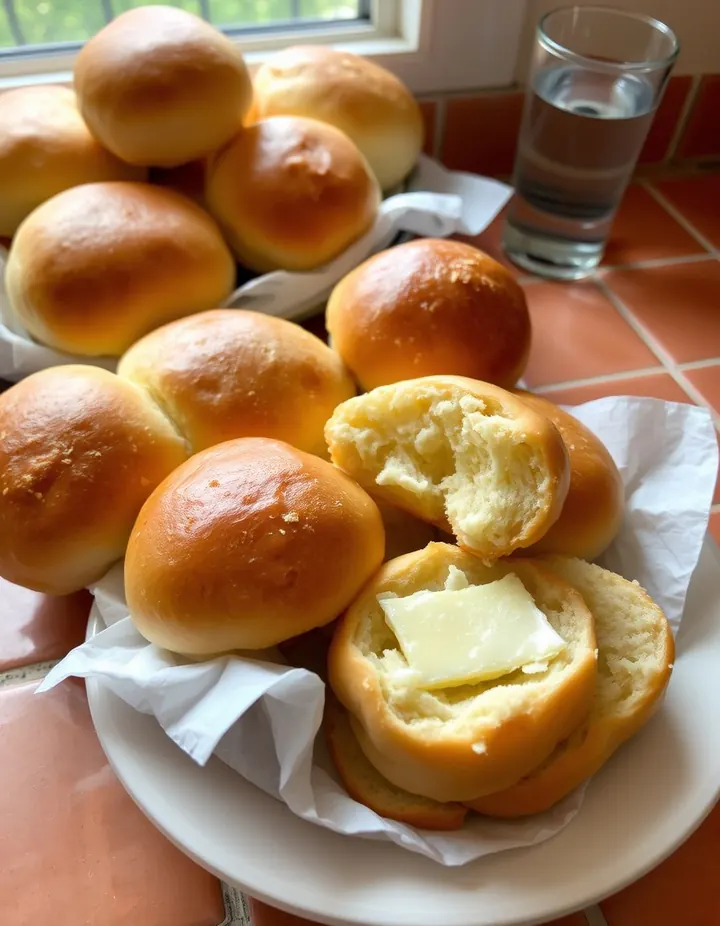
Roll out the dough to about the thickness of biscuits and cut into shapes.
Place the cut dough in a greased pan, spaced about an inch apart, and let rise again.
Mix a little milk and sugar together, then brush the mixture over the tops of the buns.
Bake in a preheated oven at 350°F (175°C) until golden brown.
Cool on a doubled cloth and store in a slanting position in the pans.
Transcribed from a scanned cookbook and modernised for today's kitchens. Where the book gave no heat or time, or said "a moderate oven", the temperatures and times here may be modern equivalents rather than the book's own figures.
Found this recipe through an AI assistant? CompKitchen also shows which ingredients go well together and why, from the aroma molecules they share and how often recipes combine them. Try the pairing tools.
Explore the science
The flavor team
The pairs that carry this dish. Each one is judged two ways: how much aroma chemistry they share, and how many recipes mention both.
-
Potato bread + flourtop 2% of all pairsAroma overlapstrongMentioned together5 recipes
Shared aroma: isobutyraldehyde (malty, green).
-
Milk + buttertop 3% of all pairsAroma overlapstrongMentioned together81,222 recipes
Shared aroma: (z)-4-heptenal (biscuit, cream).
-
Butter + flourtop 6% of all pairsAroma overlaplowMentioned together122,858 recipes
Shared aroma: isobutyraldehyde (malty, green).
-
Milk + flourtop 8% of all pairsAroma overlaplowMentioned together76,993 recipes
Shared aroma: isobutyraldehyde (malty, green).
-
Butter + eggtop 8% of all pairsAroma overlapstrongMentioned together118,511 recipes
Shared aroma: nonanal (fat, citrus).
Butter and flour share little aroma chemistry, yet 122,858 recipes mention both: they likely work on texture and structure more than aroma.
Ranks compare each pair with 20,000 random ingredient pairs on CompKitchen. How we score pairs
What each ingredient does
- Potato bread sponge
- Provides a yeasted base that makes the dough rise and gives a soft, airy crumb.
- Eggs
- Add structure and richness, helping the buns set and hold their shape.
- Butter
- Adds fat for a tender texture and richer flavor.
- Sugar
- Adds sweetness and helps the crust brown during baking.
- Flour
- Builds the gluten structure that gives the dough its body and chew.
The step that matters
Adding flour gradually to the batter. Too much flour at once makes the dough stiff and dense, while too little leaves it sticky and slack. Adding it in stages lets you reach the right consistency so the dough rises well and stays workable.
“What each ingredient does” and “The step that matters” were written by Claude, an AI, from this recipe’s own method. They are not checked recipe by recipe, so they can be wrong.
Make it your own
Stand-ins, a drink, and quick taste fixes for this dish, ranked by how well each fits its other ingredients: shared aroma molecules and how often recipes combine them.
You might also like
 Illustration
 Illustration
 Illustration
 Illustration
The Sunday pairing: one pairing, the chemistry behind it, and how to cook it. No spam, unsubscribe anytime.
Prefer an account? Create a free account for sign-in; Pro adds the full results and chemistry.