Why it works: Sugar and cranberry work together. They rank in the top 25% of all ingredient pairs, and cooks put them together in 374 recipes. Both carry 2-nonenal, which smells fatty, green. The science ↓
Cranberry Jelly
Ingredients
Directions
Prepare the isinglass
Soak the isinglass in cold water until soft.
Dissolve the isinglass in a small amount of water over low heat to make a strong jelly.
Make the jelly
In a pot, combine the sugar and cranberry juice.
Add the dissolved isinglass to the mixture and bring to a boil.
Strain the mixture into glasses or molds and let it set.
Transcribed from a scanned cookbook and modernised for today's kitchens. Where the book gave no heat or time, or said "a moderate oven", the temperatures and times here may be modern equivalents rather than the book's own figures.
Explore the science
The flavor team
The pairs that carry this dish. Each one is judged two ways: how much their aromas overlap, and how often cooks already put them together.
-
Sugar + cranberrytop 25% of all pairsSmell alikelowCooked together374 recipes
Shared aroma: 2-nonenal (fatty, green).
Ranks compare each pair with 20,000 random ingredient pairs on CompKitchen. How we score pairs
What each ingredient does
- Isinglass
- Gelatin-like setting agent that firms the juice into a jelly as it cools.
- Sugar
- Adds sweetness and balances the tartness of the cranberry juice.
- Cranberry juice
- Provides the liquid base, flavour and colour of the jelly.
The step that matters
Dissolve the isinglass in a small amount of water over low heat to make a strong jelly.. Isinglass must be fully dissolved without boiling so it keeps its setting power. Overheating can weaken its gelling strength, and undissolved pieces leave the jelly grainy or unevenly set.
“What each ingredient does” and “The step that matters” were written by Claude from this recipe’s own method and reviewed in samples by CompKitchen.
You might also like
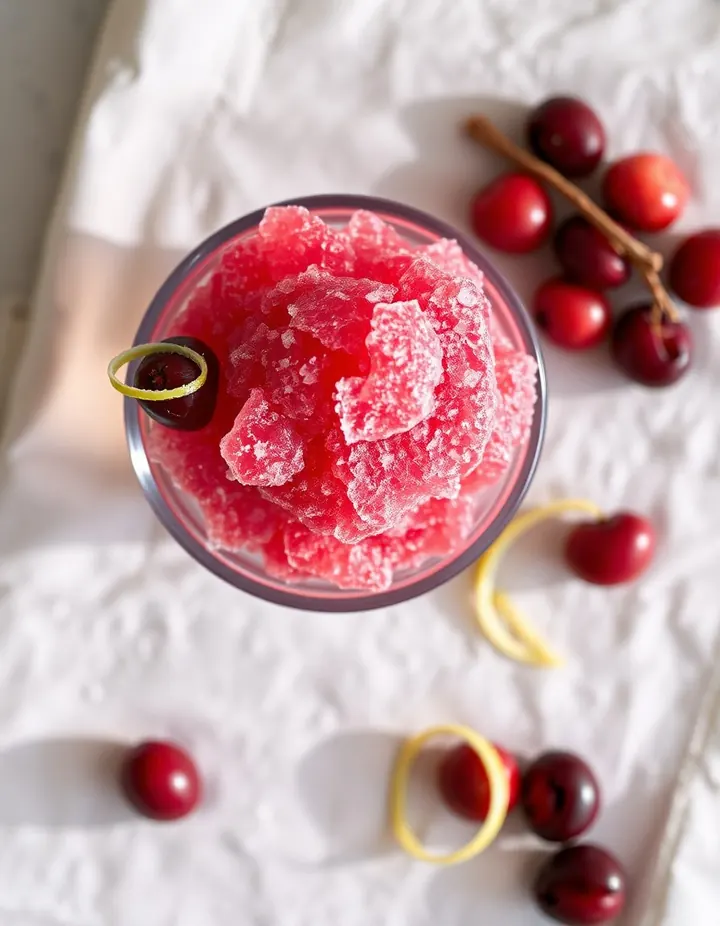 Cranberry Ice11 recipes
 White Cake431 recipes
 Pound Cake373 recipes
 Orange Bundt Cake349 recipes
The free Flavor Lab newsletter: one surprising pairing a week and the molecular reason it works, in 60 seconds. No spam, unsubscribe anytime.
Prefer an account? Create a free account to save pairings and unlock the full chemistry.