Why it works: Pepper and clove match in chemistry and in kitchens. They rank in the top 5% of all ingredient pairs, and cooks put them together in 17,451 recipes. Both carry ethyl octanoate, which smells fruity, wine. The science ↓
Boiled Beef Tongue
Ingredients
Directions
Boil the tongue
Wash the tongue.
Cover the tongue with water in a pot.
Add ½ cup coarse sea salt and a small red pepper.
Keep adding water as it evaporates to keep the tongue covered.
Cook until the tongue can be easily pierced with a fork.
Remove the tongue and let it cool.
Peel the tongue if serving soon, but do not peel it until required for future use.
Spice and cure
Mix ½ pound brown sugar and 1 tablespoon ground cloves for spiced tongue.
Rub the tongue with saltpetre (if using).
Soak the tongue in a brine of ¾ pound salt and 2 quarts water for two weeks.
Wash and dry the tongue.
Bake and finish
Roll the tongue in a thin paste of flour and water.
Place the tongue in a pan.
Bake slowly, basting with lard and hot water.
Scrape off the paste.
Scrape off the skin.
Transcribed from a scanned cookbook and modernised for today's kitchens. Where the book gave no heat or time, or said "a moderate oven", the temperatures and times here may be modern equivalents rather than the book's own figures.
Explore the science
The flavor team
The pairs that carry this dish. Each one is judged two ways: how much their aromas overlap, and how often cooks already put them together.
-
Pepper + clovetop 5% of all pairsSmell alikestrongCooked together17,451 recipes
Shared aroma: ethyl octanoate (fruity, wine).
-
Beef + peppertop 10% of all pairsSmell alikemoderateCooked together18,971 recipes
Shared aroma: 2-isopropyl-3-methoxypyrazine (earthy, pea).
-
Sauce + sugartop 13% of all pairsSmell alikestrongCooked together5,147 recipes
Shared aroma: ethanol (alcoholic, ethereal).
-
Pepper + vinegartop 14% of all pairsSmell alikemoderateCooked together27,814 recipes
Shared aroma: 4'-methylacetophenone (bitter almond).
-
Sugar + flourtop 15% of all pairsSmell alikemoderateCooked together92,116 recipes
Shared aroma: phenylacetaldehyde (hawthorne, honey).
Ranks compare each pair with 20,000 random ingredient pairs on CompKitchen. How we score pairs
What each ingredient does
- Beef tongue
- Is the main meat, becoming tender as it simmers and then bakes slowly.
- Brown sugar
- Adds sweetness and helps the surface brown and flavour the spiced coating.
- Ground cloves
- Adds a warm, aromatic spice flavour to the tongue.
- Lard
- Adds fat during basting, keeping the surface moist and promoting browning.
- Flour
- Forms a thin paste coating that shields the surface during slow baking.
- Saltpetre
- Helps cure the meat, giving it a firmer texture and a pink colour.
The step that matters
Bake slowly, basting with lard and hot water. Low, slow heat breaks down the tough connective tissue in tongue gently, while regular basting keeps the surface from drying out and scorching.
Swap the clove
How well each one fits the dish's main ingredients (beef, pepper, sauce, vinegar, sugar, flour):
- Tarragonfits better
- Jalapenofits better
- Turmericfits better
- Clovethe original
Fit is the average pairing score against beef, pepper, sauce, vinegar, sugar, flour. Candidates are from the same food group and used in at least 100 recipes.
“What each ingredient does” and “The step that matters” were written by Claude from this recipe’s own method and reviewed in samples by CompKitchen.
You might also like
 Roast Beef211 recipes
 Beef Loaf175 recipes
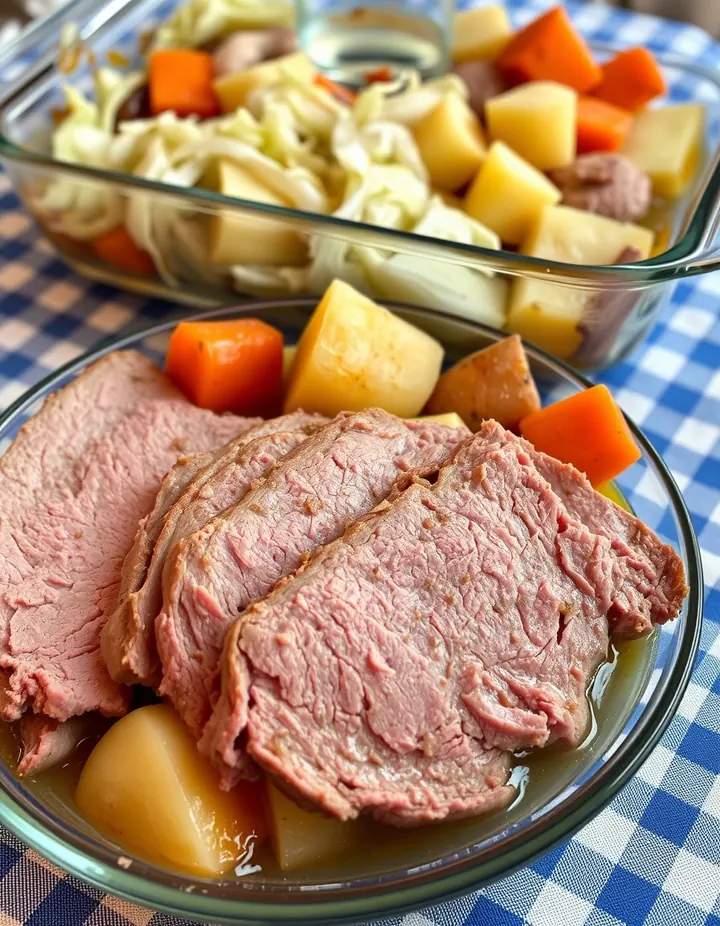 Corned Beef87 recipes
 Beef Broth67 recipes
The free Flavor Lab newsletter: one surprising pairing a week and the molecular reason it works, in 60 seconds. No spam, unsubscribe anytime.
Prefer an account? Create a free account to save pairings and unlock the full chemistry.