Why it works: Butter and flour are a kitchen classic. They rank in the top 12% of all ingredient pairs, and cooks put them together in 124,287 recipes. Both carry isobutyraldehyde, which smells malty, green. The science ↓
Veal, Quenelles of
Ingredients
Directions
Make the panada
Melt the butter in a saucepan.
Add the flour and stock, stir, and cook until it forms a compact mass around the spoon.
Set aside to cool.
Make the quenelle mixture
Pass the veal through a mincing machine or chop it finely.
Pound the panada (flour, butter, and stock) and the meat together until smooth.
Add the eggs one at a time, season to taste, and pound well together.
Rub the mixture through a wire sieve and shape into quenelles using two dessert spoons.
Dip one spoon in boiling water, fill it with the mixture, and shape it into an oval with a knife dipped in hot water.
Scoop the mixture into the second spoon and place in a buttered sauté pan.
Poach and serve
Pour in enough boiling water to nearly cover the quenelles.
Cover with greased paper and cook gently for about 30 minutes.
Drain and arrange in a circle or straight row, then mask with a good white sauce.
Transcribed from a scanned cookbook and modernised for today's kitchens. Where the book gave no heat or time, or said "a moderate oven", the temperatures and times here may be modern equivalents rather than the book's own figures.
Explore the science
The flavor team
The pairs that carry this dish. Each one is judged two ways: how much their aromas overlap, and how often cooks already put them together.
-
Butter + flourtop 12% of all pairsSmell alikelowCooked together124,287 recipes
Shared aroma: isobutyraldehyde (malty, green).
-
Flour + eggtop 15% of all pairsSmell alikelowCooked together106,462 recipes
Shared aroma: isobutyraldehyde (malty, green).
-
Butter + eggtop 17% of all pairsSmell alikemoderateCooked together118,967 recipes
Shared aroma: decanal (soap, orange peel).
-
Flour + peppertop 19% of all pairsSmell alikemoderateCooked together50,459 recipes
Shared aroma: isobutyraldehyde (malty, green).
-
Veal + peppertop 19% of all pairsSmell alikemoderateCooked together10,049 recipes
Shared aroma: 2-nonenal (fatty, green).
Butter and flour barely smell alike, yet cooks put them together in 124,287 recipes: they work on texture and structure more than aroma.
Ranks compare each pair with 20,000 random ingredient pairs on CompKitchen. How we score pairs
What each ingredient does
- Fillet of veal
- Provides the lean meat that forms the body of the quenelles.
- Flour
- Forms the panada with the stock, giving the mixture body and a light, binding structure.
- Eggs
- Bind the mixture and help it set firm during gentle cooking.
- Butter
- Enriches the panada and adds richness and softness to the quenelles.
- Stock
- Moistens the panada so the mixture stays tender rather than dry.
The step that matters
Pound the panada and meat until smooth. Thorough pounding evenly distributes the panada through the meat, so the quenelles set tender and cohesive rather than grainy or crumbly when poached.
“What each ingredient does” and “The step that matters” were written by Claude from this recipe’s own method and reviewed in samples by CompKitchen.
You might also like
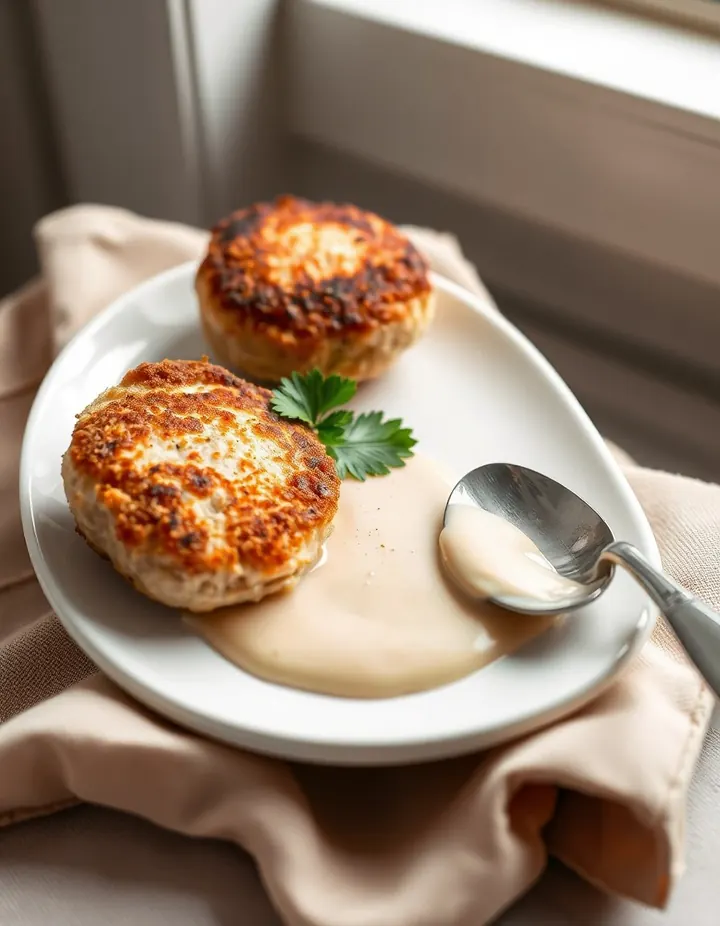 Veal Patties50 recipes
 Beef, Mutton, or Veal Broth6 recipes
 Tomato Soup526 recipes
 Brown Bread461 recipes
The free Flavor Lab newsletter: one surprising pairing a week and the molecular reason it works, in 60 seconds. No spam, unsubscribe anytime.
Prefer an account? Create a free account to save pairings and unlock the full chemistry.