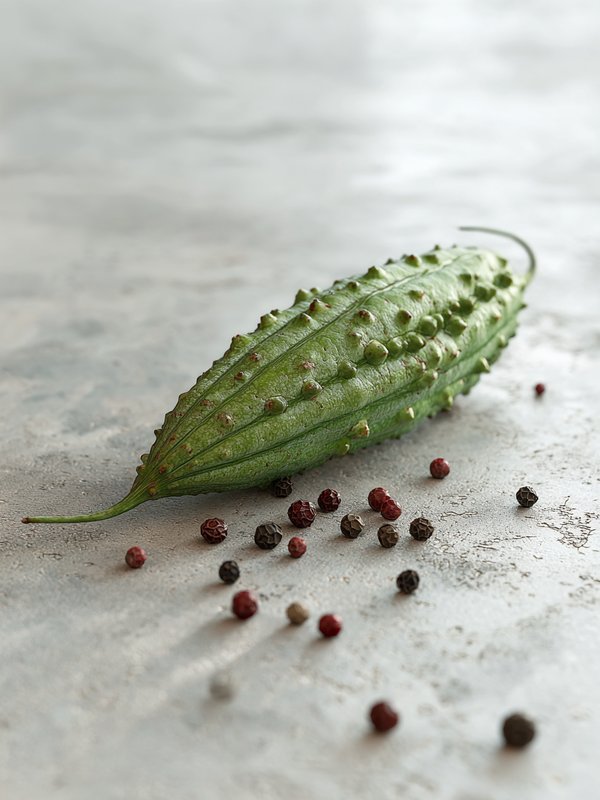
Bittergourd is a gourd whose aroma is led by cedrol (woody, amber) and myristicin (spice, warm). Cooks pair it most with onion, olive and garlic. By shared aroma its closest partners are poppy seed, french plantain and okra.
What goes with bittergourd
The classics
- Onion: cooked together in 7 recipes, with moderate shared aroma, including coumarin (sweet, hay).
- Olive: cooked together in 6 recipes, with moderate shared aroma, including eucalyptol (eucalyptus, herbal).
- Garlic: cooked together in 5 recipes, with moderate shared aroma, including beta-phellandrene (minty, terpene).
- Turmeric: cooked together in 5 recipes, with moderate shared aroma, including eucalyptol (eucalyptus, herbal).
- Sugar: cooked together in 4 recipes, though they share little aroma: this one is a cooking habit more than a chemical match.
Worth trying
- Redskin onion Hidden gem: strong shared aroma (84 molecules), yet no recipe in our collection combines them.
- Hogplum Hidden gem: strong shared aroma (84 molecules), yet no recipe in our collection combines them.
A hidden gem is a lead to test, not a proven pairing: strong shared chemistry, but cooks have barely tried it.
Bittergourd pairing chart
Scroll sideways to see every column →
| Partner | Shared aroma | Shared molecules | Recipes together | Rank among all pairs |
|---|---|---|---|---|
| turmeric | moderate | 90 | 5 | top 8% |
| kai lan | strong | 83 | 0 | top 14% |
| yellow pond lily | strong | 84 | 0 | top 14% |
| pepper c. baccatum | strong | 83 | 0 | top 15% |
| small leaf linden | strong | 83 | 0 | top 15% |
| ashgourd | strong | 84 | 0 | top 15% |
| pepper c. chinense | strong | 83 | 0 | top 16% |
| carom seed | strong | 93 | 0 | top 16% |
| poppy seed | strong | 88 | 1 | top 16% |
| eggplant | moderate | 86 | 2 | top 17% |
| coconut | moderate | 87 | 3 | top 17% |
| garlic | moderate | 86 | 5 | top 18% |
| olive | moderate | 88 | 6 | top 18% |
| bitter cherry | strong | 84 | 0 | top 18% |
| fenugreek | moderate | 84 | 2 | top 18% |
| hogplum | strong | 84 | 0 | top 19% |
| coriander | moderate | 95 | 3 | top 19% |
| lime | moderate | 92 | 1 | top 19% |
| redskin onion | strong | 84 | 0 | top 19% |
| beans | moderate | 86 | 2 | top 19% |
Ordered by pairing score. Shared aroma: how much of their aroma chemistry overlaps (strong, moderate or low against all ingredient pairs). Rank: where the pair sits among random ingredient pairs on CompKitchen. Shared molecules counts every molecule the two have in common, not only aroma ones. Each partner links to a side-by-side comparison.
Bittergourd flavor profile
Bittergourd carries 107 flavor molecules in our data, 74 of them volatile enough to smell and 33 of them key food odorants, the molecules shown to drive food aroma. The aromas that lead its profile, strongest measured first: cedrol (woody, amber), myristicin (spice, warm), spathulenol (earthy, herbal) and p-cymene (solvent, gasoline).
Why bittergourd pairs the way it does
Bittergourd's pairing hooks are alpha-pinene (pine, turpentine), which 4 of its 10 best partners also carry but only 19% of all ingredients do. Partners that share them, like turmeric, carom seed and poppy seed, share more with bittergourd than the background chemistry most foods carry.
How cooks use bittergourd
Key aroma molecules in bittergourd
Scroll sideways to see every column →
| Molecule | Smells like | Why it matters |
|---|---|---|
| cedrol | woody, amber, floral | In 21 of 861 ingredients. |
| myristicin | spice, warm, balsamic | In 22 of 861 ingredients; a key food odorant. Shared with carom seed. |
| spathulenol | earthy, herbal, woody | In 30 of 861 ingredients. |
| p-cymene | solvent, gasoline, citrus | In 91 of 861 ingredients. Shared with turmeric, carom seed and poppy seed. |
| beta-phellandrene | minty, terpene, peppery | In 47 of 861 ingredients; a key food odorant. Shared with carom seed. |
| alpha-pinene | pine, turpentine | In 167 of 861 ingredients; a key food odorant. Shared with turmeric, carom seed and poppy seed. |
| nerolidol | floral, green, woody | In 84 of 861 ingredients. |
| linalool | floral, citrus, woody | In 238 of 861 ingredients; a key food odorant. Shared with turmeric and carom seed. |
Ordered by measured strength in bittergourd (concentration against odour threshold) where studies report it, then by how rare the molecule is across foods. Smell words are each molecule's own published description. Key food odorants are the molecules shown to drive food aroma (Dunkel et al. 2014).
Does it go with what you have?
ButterUntested
No recipe in our pairing index uses both, low shared aroma, bottom 19% of pairs. Compare →
LemonSometimes
Cooked together in 1 recipe, moderate shared aroma, top 34% of pairs. They share beta-phellandrene (minty, terpene). Compare →
GarlicSometimes
Cooked together in 5 recipes, moderate shared aroma, top 18% of pairs. They share beta-phellandrene (minty, terpene). Compare →
SugarSometimes
Cooked together in 4 recipes, low shared aroma, top 47% of pairs. Compare →
ChiliSometimes
Cooked together in 2 recipes, moderate shared aroma, top 22% of pairs. They share eucalyptol (eucalyptus, herbal). Compare →
GingerSometimes
Cooked together in 1 recipe, moderate shared aroma, top 32% of pairs. They share beta-phellandrene (minty, terpene). Compare →
Bittergourd pairing questions
What makes bittergourd smell like bittergourd?
Its leading aroma molecules are cedrol (woody, amber), myristicin (spice, warm) and spathulenol (earthy, herbal), out of the 74 aroma molecules on record for it.
What's a good substitute for bittergourd?
The closest molecular substitutes for bittergourd are pepper c. chinense, redskin onion, bitter cherry — ingredients that share the highest fraction of bittergourd's flavor compounds.
Is bittergourd vegan, gluten-free, or kosher?
Bittergourd is vegan and is gluten-free, dairy-free, nut-free, kosher, halal.
The science in full
All 107 molecules on record
17 of 107 are distinctive to bittergourd (in under 10% of foods). Ordered by measured impact in bittergourd, then by how distinctive the molecule is.
254 research papers on bittergourd
- GC-MS olfactometric characterization of odor active compounds in cooked red kidney beans (Phaseolus vulgaris). · 2019
- Ascorbic acid contents of Pakistani fruits and vegetables. Pakistan journal of pharmaceutical sciences · 2006
- Valorization of tea stems: Dynamic changes in volatile and non-volatile components via Tencha processing. · 2026
- Multi-omics insights into the formation mechanism of aging quality in white tea (Bai Mudan) during storage: Integrating sensory evaluation, volatilomics, metabolomics, and metagenomics. · 2025
- Correlation study on microbial communities and volatile flavor compounds in cigar tobacco leaves of diverse origins. Applied microbiology and biotechnology · 2024
Explore more: pair it · find substitutes · discover novel pairings · get this data via the API · how we score pairs