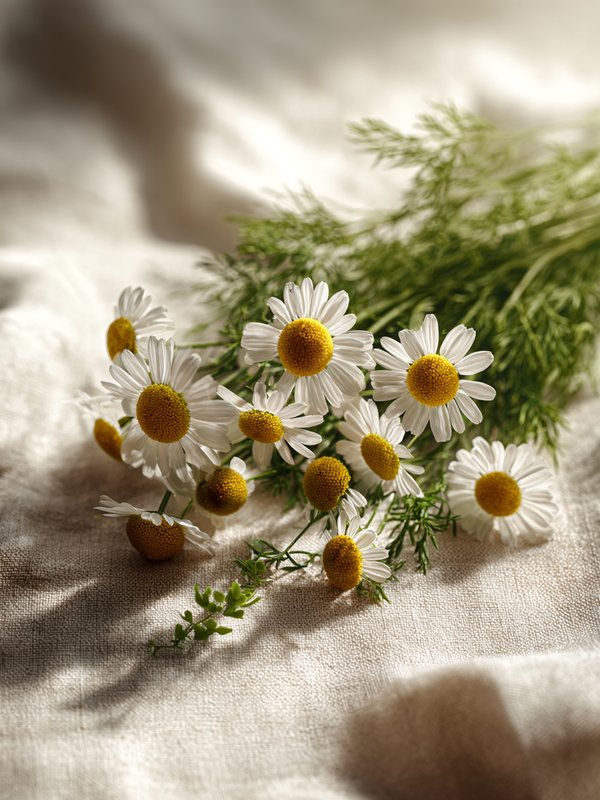
Chamomile is an essential oil whose aroma is led by artemisia ketone (green, herb) and isoamyl propionate (banana, bitter). Cooks pair it most with sugar, tea and brandy. By shared aroma its closest partners are sage, spearmint and laurel.
What goes with chamomile
The classics
- Sugar: cooked together in 16 recipes, though they share little aroma: this one is a cooking habit more than a chemical match.
- Tea: cooked together in 13 recipes, with moderate shared aroma, including damascenone (apple, rose).
- Brandy: cooked together in 10 recipes, though they share little aroma: this one is a cooking habit more than a chemical match.
- Egg: cooked together in 10 recipes, though they share little aroma: this one is a cooking habit more than a chemical match.
- Olive: cooked together in 10 recipes, with moderate shared aroma, including ethyl isobutyrate (fruity, ethereal).
Unexpected partners
- Lemon: Moderate shared aroma, including eucalyptol (eucalyptus, herbal); 9 recipes combine them.
Worth trying
- Hyssop oil Hidden gem: shares 115 flavor molecules with chamomile, more than sugar's 8, yet no recipe in our collection combines them.
- Sage Hidden gem: shares 132 flavor molecules with chamomile, more than sugar's 8, yet only 1 recipe in our collection combines them.
A hidden gem is a lead to test, not a proven pairing: strong shared chemistry, but cooks have barely tried it.
Chamomile pairing chart
Scroll sideways to see every column →
| Partner | Shared aroma | Shared molecules | Recipes together | Rank among all pairs |
|---|---|---|---|---|
| honey | moderate | 75 | 5 | top 14% |
| tea | moderate | 134 | 13 | top 14% |
| laurel | moderate | 129 | 4 | top 14% |
| fig | moderate | 127 | 4 | top 14% |
| rhubarb | moderate | 107 | 9 | top 15% |
| ginger | moderate | 135 | 4 | top 15% |
| thyme | moderate | 124 | 3 | top 15% |
| cassia | moderate | 107 | 3 | top 15% |
| peppermint | moderate | 133 | 5 | top 15% |
| spirit | low | 21 | 10 | top 15% |
| mint | moderate | 105 | 4 | top 16% |
| lemon | moderate | 117 | 9 | top 16% |
| whisky | moderate | 31 | 7 | top 17% |
| apple | moderate | 140 | 2 | top 17% |
| clove | moderate | 115 | 4 | top 17% |
| burdock | moderate | 99 | 4 | top 17% |
| cardamom | moderate | 117 | 2 | top 17% |
| brandy | low | 22 | 10 | top 18% |
| marjoram | moderate | 128 | 4 | top 18% |
| orange | moderate | 132 | 7 | top 18% |
Ordered by pairing score. Shared aroma: how much of their aroma chemistry overlaps (strong, moderate or low against all ingredient pairs). Rank: where the pair sits among random ingredient pairs on CompKitchen. Shared molecules counts every molecule the two have in common, not only aroma ones. Each partner links to a side-by-side comparison.
Chamomile flavor profile
Chamomile carries 231 flavor molecules in our data, 129 of them volatile enough to smell and 45 of them key food odorants, the molecules shown to drive food aroma. The aromas that lead its profile, strongest measured first: artemisia ketone (green, herb), isoamyl propionate (banana, bitter), geranyl isovalerate (fruit, rose) and ethyl isobutyrate (fruity, ethereal).
Why chamomile pairs the way it does
Chamomile's pairing hooks are beta-pinene (pine, resin), which 8 of its 10 best partners also carry but only 17% of all ingredients do; and myrcene (balsamic, herbaceous), which 8 of its 10 best partners also carry but only 19% of all ingredients do. Partners that share them, like honey, tea and laurel, share more with chamomile than the background chemistry most foods carry. Partners that share little aroma, like sugar and spirit, pair through cooking habit instead: 16 and 10 recipes respectively.
How cooks use chamomile
Key aroma molecules in chamomile
Scroll sideways to see every column →
| Molecule | Smells like | Why it matters |
|---|---|---|
| artemisia ketone | green, herb | In 4 of 861 ingredients. |
| isoamyl propionate | banana, bitter, fruit | In 18 of 861 ingredients. Shared with peppermint. |
| geranyl isovalerate | fruit, rose, apple | In 9 of 861 ingredients. |
| ethyl isobutyrate | fruity, ethereal, sweet | In 62 of 861 ingredients; a key food odorant. Shared with honey, laurel and fig. |
| ethyl 2-methylbutyrate | fruity, apple, sweet | In 74 of 861 ingredients; a key food odorant. Shared with fig. |
| beta-bisabolene | balsamic woody | In 27 of 861 ingredients. Shared with laurel and ginger. |
| cedrol | woody, amber, floral | In 21 of 861 ingredients. Shared with honey, ginger and peppermint. |
| 3-methylbutyl 2-methylbutanoate | fruity, apple, sweet | In 13 of 861 ingredients. |
Ordered by measured strength in chamomile (concentration against odour threshold) where studies report it, then by how rare the molecule is across foods. Smell words are each molecule's own published description. Key food odorants are the molecules shown to drive food aroma (Dunkel et al. 2014).
Does it go with what you have?
ButterSometimes
Cooked together in 7 recipes, low shared aroma, top 33% of pairs. Compare →
LemonClassic
Cooked together in 9 recipes, moderate shared aroma, top 16% of pairs. They share eucalyptol (eucalyptus, herbal). Compare →
GarlicSometimes
Cooked together in 1 recipe, moderate shared aroma, top 47% of pairs. They share coumarin (sweet, hay). Compare →
SugarHabit
Cooked together in 16 recipes, low shared aroma, top 33% of pairs. Compare →
ChiliSometimes
Cooked together in 6 recipes, moderate shared aroma, top 20% of pairs. They share ethyl isobutyrate (fruity, ethereal). Compare →
GingerSometimes
Cooked together in 4 recipes, moderate shared aroma, top 15% of pairs. They share eucalyptol (eucalyptus, herbal). Compare →
Chamomile pairing questions
What makes chamomile smell like chamomile?
Its leading aroma molecules are artemisia ketone (green, herb), isoamyl propionate (banana, bitter) and geranyl isovalerate (fruit, rose), out of the 129 aroma molecules on record for it.
What's a good substitute for chamomile?
The closest molecular substitutes for chamomile are hyssop oil, artemisia, turmeric — ingredients that share the highest fraction of chamomile's flavor compounds.
Is chamomile vegan, gluten-free, or kosher?
Chamomile is vegan and is gluten-free, dairy-free, nut-free, kosher, halal.
The science in full
Scientific name: Matricaria chamomilla. Wikidata Q28437 (CC0)
All 231 molecules on record
115 of 231 are distinctive to chamomile (in under 10% of foods). Ordered by measured impact in chamomile, then by how distinctive the molecule is.
553 research papers on chamomile
- Upcycling Roman Chamomile Hydrolate and Apple Pomace Agri-Wastes into Sustainable Cosmetic Ingredients. · 2026
- Influence of Drying Methods on Volatile Aroma Compounds and Sensory Properties of Olive Leaf Herbal Tea. · 2026
- Quality comparison of Gastrodia elata grown using artificial mushroom cultivation kits and traditional wood-based cultivation. · 2025
- Characterization of Terpenoids in Aromatic Plants Using Raman Spectroscopy and Gas Chromatography-Mass Spectrometry (GC-MS). · 2025
- Effect of Phenolic Compounds and Terpenes on the Flavour and Functionality of Plant-Based Foods. · 2025
Explore more: pair it · find substitutes · discover novel pairings · get this data via the API · how we score pairs