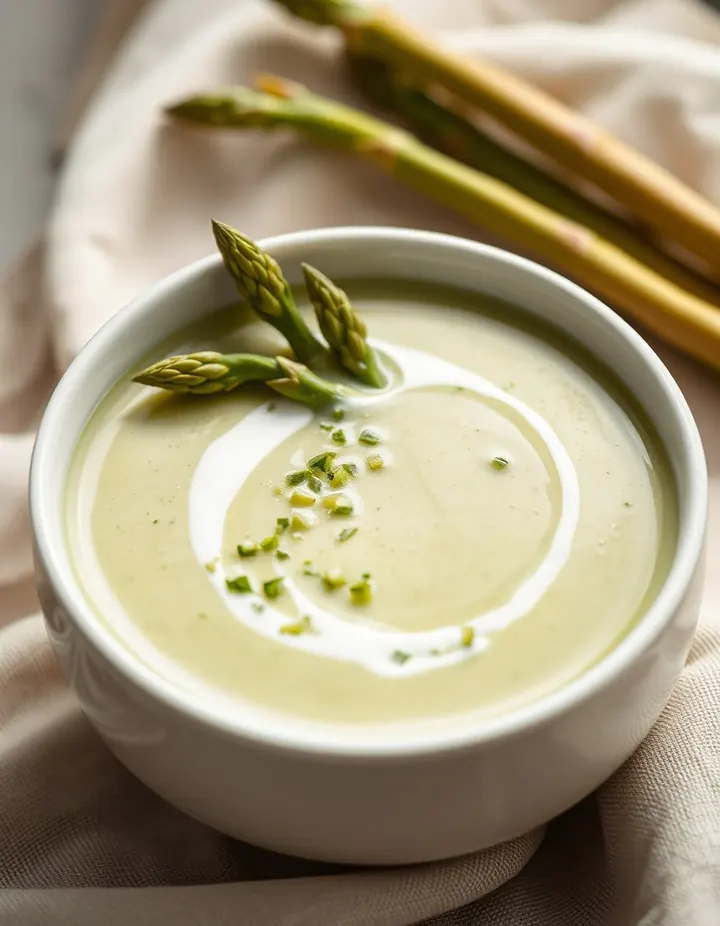
 Illustration
Why it works: Asparagus and shallot match in chemistry and in kitchens. They rank in the top 4% of all ingredient pairs, and 137 recipes mention both. Both carry 2-octenal, which smells fatty, green. The science ↓
The recipe
Serves 4Ingredients
Contains: milk (auto-detected from the ingredients and method; we can miss things, so check labels)
Directions
Prepare the asparagus
Snap the tough ends off the asparagus spears.
Bring the water to a boil in a medium saucepan and salt the water lightly.
Add the asparagus spears and cook at a lively simmer for 10 minutes.
Lift out the asparagus with tongs and set aside, reserving the cooking water.
Make the soup base
In a separate saucepan large enough to hold the finished soup, heat the butter.
Add the chopped shallot and cook gently until soft but not browned.
Add the cooked asparagus spears and one cup of the cooking water, and bring to a boil.
Cook at a lively simmer for 5 minutes, then remove from the heat.
Strain and purée
Strain the soup through a medium sieve into a bowl, reserving the liquid.
Purée the solids in a food processor with enough of the reserved liquid to allow the mixture to purée smoothly.
Strain the purée through the sieve back into the non-reactive saucepan, rubbing the mixture through with a flexible scraper or wooden spoon.
Leave the fibrous parts in the sieve and discard them.
Finish and serve
Add the cream and enough of the remaining asparagus cooking water to give the soup the consistency you want.
Season to taste with salt, freshly ground black pepper, and cayenne pepper.
Reheat gently over low heat, making sure not to let the soup boil.
Serve hot or chilled.
To serve chilled, let it cool, then refrigerate it uncovered until thoroughly cold.
Cover with plastic wrap and keep refrigerated for up to 2 days.
Steps grouped into stages for easier reading; the method is the source's own.
Found this recipe through an AI assistant? CompKitchen also shows which ingredients go well together and why, from the aroma molecules they share and how often recipes combine them. Try the pairing tools.
The picture is an illustration, not a photo of this recipe · Contact us to use it
Explore the science
The flavor team
The pairs that carry this dish. Each one is judged two ways: how much aroma chemistry they share, and how many recipes mention both.
-
Asparagus + shallottop 4% of all pairsAroma overlapstrongMentioned together137 recipes
Shared aroma: 2-octenal (fatty, green).
-
Butter + creamtop 3% of all pairsAroma overlapstrongMentioned together41,494 recipes
Shared aroma: delta-dodecalactone (sweet, creamy).
-
Asparagus + peppertop 6% of all pairsAroma overlapstrongMentioned together1,968 recipes
Shared aroma: 2-isopropyl-3-methoxypyrazine (earthy, pea).
-
Shallot + peppertop 8% of all pairsAroma overlapmoderateMentioned together5,849 recipes
Shared aroma: 2-heptenal (green).
-
Asparagus + buttertop 9% of all pairsAroma overlapstrongMentioned together2,022 recipes
Shared aroma: guaiacol (smoky, sweet).
Ranks compare each pair with 20,000 random ingredient pairs on CompKitchen. How we score pairs
What each ingredient does
- Asparagus spears
- Provides the main flavour and the bulk of the soup's body once puréed.
- Unsalted butter
- Carries flavour and gives the soup a rich, smooth mouthfeel.
- Shallot
- Adds a mild, sweet aromatic base when softened gently without browning.
- Whipping or light cream
- Adds richness and a silky texture, and helps set the final consistency.
The step that matters
Cook the shallot gently until soft but not browned. Browning the shallot adds bitter, harsh notes that would carry into the whole soup. Slow, gentle cooking softens it and builds a sweet, mild base.
Flavor stand-ins for the shallot
How well each one fits the dish's main ingredients (asparagus, butter, cream, pepper):
- Potatobetter flavor fit
- Spinachbetter flavor fit
- Leekbetter flavor fit
- Shallotthe original
Fit is the average pairing score against asparagus, butter, cream, pepper. Candidates are from the same food group and used in at least 100 recipes. This compares flavor only: it does not check the job the ingredient does in the dish (bulk, moisture, acidity, structure).
“What each ingredient does” and “The step that matters” were written by Claude, an AI, from this recipe’s own method. They are not checked recipe by recipe, so they can be wrong.
Make it your own
Stand-ins, a drink, and quick taste fixes for this dish, ranked by how well each fits its other ingredients: shared aroma molecules and how often recipes combine them.
You might also like
 Illustration
 Illustration
 Illustration
 Illustration
The Sunday pairing: one pairing, the chemistry behind it, and how to cook it. No spam, unsubscribe anytime.
Prefer an account? Create a free account for sign-in; Pro adds the full results and chemistry.