Why it works: Lemon and butter are a kitchen classic. They rank in the top 16% of all ingredient pairs, and cooks put them together in 41,227 recipes. Both carry 3-hexenal, which smells apple, fruity. The science ↓
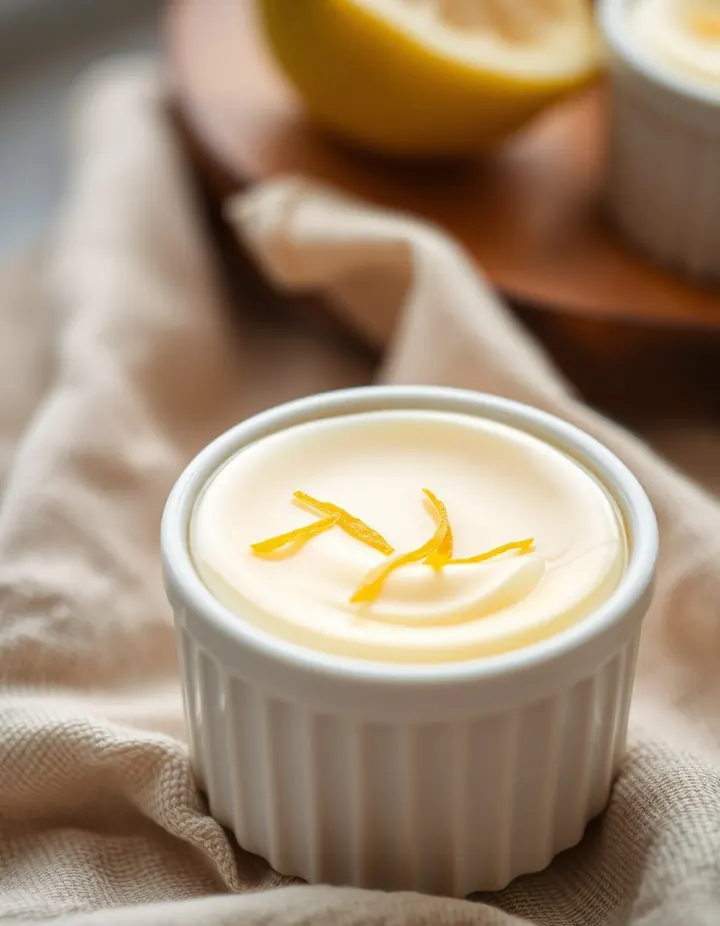
Lemon Curd
12 ounces (330 g)Ingredients
Directions
Prepare the base
Cut the butter into small chunks.
Put eggs, zest, sugar, and salt into saucepan.
Whisk ingredients in pan until frothy and light in color (1–2 minutes).
Add lemon juice and whisk for 30 seconds.
Add butter chunks.
Make the curd
Set pan on stove burner, turn on heat to medium‑to‑low, and start whisking contents so they don't coagulate or stick to bottom of pan.
Whisk constantly until butter melts and mixture thickens.
Whisk another two minutes. Do not let mixture boil. It should be quite steamy (about 185°F / 85°C).
Strain and jar
Pour the mixture through the strainer to remove the zest and any other solids.
Work the mixture through the strainer with the spatula.
Rake mixture off bottom of strainer into bowl.
Pour mixture from bowl into jar to within ¼ inch (0.75 cm) from top, taking care not to get mixture on rim, then seal jar with lid.
Refrigerate to thicken the product further. Store in the refrigerator.
Nutrition, whole recipe (rough)
What these numbers assume: 5 portions
| Ingredient | Portion assumed | kcal |
|---|---|---|
| Butter | 1 tbsp (14g) | 102 |
| Egg | 1 large egg (50g) | 78 |
| Sugar | 1 tbsp (12.5g) granulated | 49 |
| Lemon | juice of 1 lemon (48ml) | 12 |
| Salt | 1 tsp (6g) | 0 |
One typical portion per ingredient; the recipe's quantities are not counted. A rough guide only, not for medical or dietary planning.
Steps grouped into stages for easier reading; the method is the source's own.
Explore the science
The flavor team
The pairs that carry this dish. Each one is judged two ways: how much their aromas overlap, and how often cooks already put them together.
-
Lemon + buttertop 16% of all pairsSmell alikemoderateCooked together41,227 recipes
Shared aroma: 3-hexenal (apple, fruity).
-
Egg + buttertop 17% of all pairsSmell alikemoderateCooked together118,967 recipes
Shared aroma: decanal (soap, orange peel).
-
Sugar + buttertop 17% of all pairsSmell alikemoderateCooked together98,233 recipes
Shared aroma: guaiacol (smoky, sweet).
-
Lemon + sugartop 18% of all pairsSmell alikelowCooked together53,532 recipes
Shared aroma: 2-nonenal (fatty, green).
-
Lemon + eggtop 19% of all pairsSmell alikelowCooked together44,316 recipes
Shared aroma: (e,e)-2,4-decadienal (fatty, deep fried).
Lemon and sugar barely smell alike, yet cooks put them together in 53,532 recipes: they work on texture and structure more than aroma.
Ranks compare each pair with 20,000 random ingredient pairs on CompKitchen. How we score pairs
What each ingredient does
- Eggs
- Coagulate when heated gently, thickening the curd into a spoonable custard.
- Lemon juice
- Provides the sharp acidity that defines the curd's bright flavor.
- Sugar
- Sweetens the curd and balances the acidity of the lemon juice.
- Unsalted butter
- Adds richness and a smooth, glossy texture to the finished curd.
- Lemon zest
- Adds concentrated lemon aroma and oils to the curd.
The step that matters
Cook gently without boiling. Egg proteins set as the curd heats, but if the mixture boils or overheats, the eggs scramble and the curd turns grainy. Constant whisking over medium-to-low heat spreads heat evenly and keeps it smooth.
Swap the lemon
How well each one fits the dish's main ingredients (sugar, egg, butter):
- Vanillafits better
- Lemonthe original
- Raisinfits about as well
- Figfits about as well
Fit is the average pairing score against sugar, egg, butter. Candidates are from the same food group and used in at least 100 recipes.
“What each ingredient does” and “The step that matters” were written by Claude from this recipe’s own method and reviewed in samples by CompKitchen.
You might also like
 Lemon Cake228 recipes
 Lemon Ice147 recipes
 Lemon Sherbet103 recipes
 Lemon Custard64 recipes
The free Flavor Lab newsletter: one surprising pairing a week and the molecular reason it works, in 60 seconds. No spam, unsubscribe anytime.
Prefer an account? Create a free account to save pairings and unlock the full chemistry.