Why it works: Milk and flour are a kitchen classic. They rank in the top 14% of all ingredient pairs, and cooks put them together in 78,219 recipes. Both carry isobutyraldehyde, which smells malty, green. The science ↓
Brioche Cakes
Ingredients
Directions
Prepare the dough
Grate the rind of half a lemon and squeeze the juice from half a lemon.
Dissolve yeast in lukewarm milk.
Add one and one-half cups of flour, sugar, and salt to the mixture; cover and let rise until light and bubbly.
Add well-beaten eggs and the remaining ingredients, adding a cup and one-half more of flour, beating well.
Let dough rise twice the bulk.
Shape and bake
Roll dough on a slightly floured board to a half-inch thickness.
Spread softened butter over dough, fold both sides to the center to create three layers.
Cut strips three-fourths of an inch wide.
Cover and let rise.
Fold ends together to form a circle.
Let rise again twice the size.
Bake for twenty minutes.
Make the rusks
Make the dough for rusks in one large loaf the same shape as the rusks, or two loaves can be made from it if small.
Let rise and bake well.
When cold, cut into half-inch slices and dry them in a very slow oven until dried through and deep yellow.
Nutrition, whole recipe (rough)
Counts 6 of 7 ingredients. The other 1 aren't in our nutrition table and add nothing above, so the real totals are higher.
What these numbers assume: 6 portions
| Ingredient | Portion assumed | kcal |
|---|---|---|
| Flour | 1 cup (125g) all-purpose | 455 |
| Milk | 1 cup (244ml) whole | 149 |
| Egg | 1 large egg (50g) | 78 |
| Sugar | 1 tbsp (12.5g) granulated | 49 |
| Lemon | juice of 1 lemon (48ml) | 12 |
| Salt | 1 tsp (6g) | 0 |
| Cake | not in our table | 0 |
One typical portion per ingredient; the recipe's quantities are not counted. A rough guide only, not for medical or dietary planning.
Transcribed from a scanned cookbook and modernised for today's kitchens. Where the book gave no heat or time, or said "a moderate oven", the temperatures and times here may be modern equivalents rather than the book's own figures. See the original page.
Explore the science
The flavor team
The pairs that carry this dish. Each one is judged two ways: how much their aromas overlap, and how often cooks already put them together.
-
Milk + flourtop 14% of all pairsSmell alikelowCooked together78,219 recipes
Shared aroma: isobutyraldehyde (malty, green).
-
Sugar + flourtop 15% of all pairsSmell alikemoderateCooked together92,116 recipes
Shared aroma: phenylacetaldehyde (hawthorne, honey).
-
Milk + lemontop 15% of all pairsSmell alikemoderateCooked together19,053 recipes
Shared aroma: 2-nonenal (fatty, green).
-
Flour + eggtop 15% of all pairsSmell alikelowCooked together106,462 recipes
Shared aroma: isobutyraldehyde (malty, green).
-
Flour + lemontop 17% of all pairsSmell alikemoderateCooked together30,404 recipes
Shared aroma: isobutyraldehyde (malty, green).
Milk and flour barely smell alike, yet cooks put them together in 78,219 recipes: they work on texture and structure more than aroma.
Ranks compare each pair with 20,000 random ingredient pairs on CompKitchen. How we score pairs
What each ingredient does
- Eggs
- Add structure and richness, helping the dough bind and bake with a tender crumb.
- Flour
- Forms the gluten network that gives the dough its structure and lets it hold rising gas.
- Yeast
- Produces carbon dioxide as it ferments, making the dough rise and become light.
- Milk
- Moistens the dough and softens its texture, while supplying sugars that brown lightly in the oven.
- Sugar
- Feeds the yeast and adds sweetness and some browning in the baked crust.
- Butter (in the method)
- Adds fat that tenderises the layers and gives a rich flavour.
The step that matters
Let the dough rise until light and bubbly before adding the eggs and remaining flour. Yeast needs time to become active and build gas; rising too little leaves the cakes dense, while the later rises depend on this early fermentation being well established.
Swap the lemon
How well each one fits the dish's main ingredients (milk, sugar, flour, egg):
- Vanillafits better
- Raisinfits better
- Figfits better
- Lemonthe original
Fit is the average pairing score against milk, sugar, flour, egg. Candidates are from the same food group and used in at least 100 recipes.
“What each ingredient does” and “The step that matters” were written by Claude from this recipe’s own method and reviewed in samples by CompKitchen.
You might also like
 Lemon Cake228 recipes
 Lemon Ice147 recipes
 Lemon Sherbet103 recipes
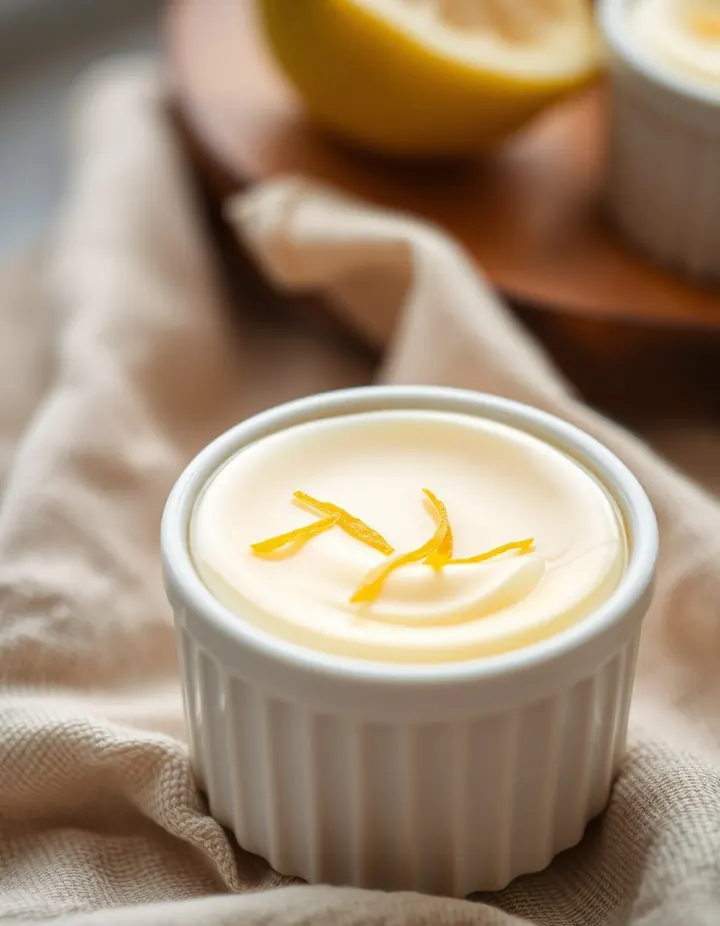 Lemon Custard64 recipes
The free Flavor Lab newsletter: one surprising pairing a week and the molecular reason it works, in 60 seconds. No spam, unsubscribe anytime.
Prefer an account? Create a free account to save pairings and unlock the full chemistry.