Why it works: Ginger and cinnamon match in chemistry and in kitchens. They rank in the top 1% of all ingredient pairs, and cooks put them together in 6,380 recipes. Both carry estragole, which smells anise, licorice. The science ↓
Eccles Cakes or Tarts
Ingredients
Directions
Prepare the filling
Combine currants, sugar, lemon peel, ginger, and cinnamon; mix well.
Shape the pastries
Prepare short-crust or puff pastry, roll to 1/4 inch thick, and cut into 2-inch squares.
Place a teaspoon of the currant mixture in the center of each square; fold edges over to enclose the filling, leaving a small opening.
Flatten the pastries with your hand, turn them over (folded part down), and roll out with a rolling pin until the filling breaks through.
Bake
Place the pastries on baking pans, cut a few slashes across the top with a knife, wash the tops with milk or milk and egg, and dust with sugar.
Bake at 375°F until nicely browned.
Nutrition, whole recipe (rough)
What these numbers assume: 5 portions
| Ingredient | Portion assumed | kcal |
|---|---|---|
| Sugar | 1 tbsp (12.5g) granulated | 49 |
| Lemon Peel | juice of 1 lemon (48ml) | 12 |
| Lemon | juice of 1 lemon (48ml) | 12 |
| Cinnamon | 1 tsp ground (2.6g) | 6 |
| Ginger | 1 tsp grated fresh (2g) | 2 |
One typical portion per ingredient; the recipe's quantities are not counted. A rough guide only, not for medical or dietary planning.
Transcribed from a scanned cookbook and modernised for today's kitchens. Where the book gave no heat or time, or said "a moderate oven", the temperatures and times here may be modern equivalents rather than the book's own figures. See the original page.
Explore the science
The flavor team
The pairs that carry this dish. Each one is judged two ways: how much their aromas overlap, and how often cooks already put them together.
-
Ginger + cinnamontop 1% of all pairsSmell alikestrongCooked together6,380 recipes
Shared aroma: estragole (anise, licorice).
-
Lemon + gingertop 5% of all pairsSmell alikestrongCooked together5,154 recipes
Shared aroma: beta-phellandrene (minty, terpene).
-
Lemon + cinnamontop 7% of all pairsSmell alikestrongCooked together7,950 recipes
Shared aroma: beta-phellandrene (minty, terpene).
-
Sugar + cinnamontop 10% of all pairsSmell alikelowCooked together30,779 recipes
Shared aroma: guaiacol (smoky, sweet).
-
Sugar + gingertop 17% of all pairsSmell alikelowCooked together14,054 recipes
Shared aroma: 1-penten-3-one (fish, pungent).
Sugar and cinnamon barely smell alike, yet cooks put them together in 30,779 recipes: they work on texture and structure more than aroma.
Ranks compare each pair with 20,000 random ingredient pairs on CompKitchen. How we score pairs
What each ingredient does
- Currants (in the method)
- Provide the sweet, chewy fruit filling that defines the pastry.
- Sugar
- Adds sweetness and helps the tops brown when dusted over the pastry.
- Lemon peel
- Adds bright aromatic citrus flavour that balances the sweet filling.
- Ginger
- Adds warm, spicy aroma to the currant filling.
- Cinnamon
- Adds warm sweet spice aroma to the filling.
The step that matters
Rolling until the filling breaks through. Rolling too little leaves the filling enclosed and the pastry thick, while over-rolling tears the thin dough and lets currants burn on the pan. Flattening gently just until the filling shows keeps the pastry even and the filling sealed enough to bake well.
Swap the lemon
How well each one fits the dish's main ingredients (sugar, ginger, cinnamon):
- Vanillafits better
- Raisinfits better
- Orangefits better
- Lemonthe original
Fit is the average pairing score against sugar, ginger, cinnamon. Candidates are from the same food group and used in at least 100 recipes.
“What each ingredient does” and “The step that matters” were written by Claude from this recipe’s own method and reviewed in samples by CompKitchen.
You might also like
 Lemon Cake228 recipes
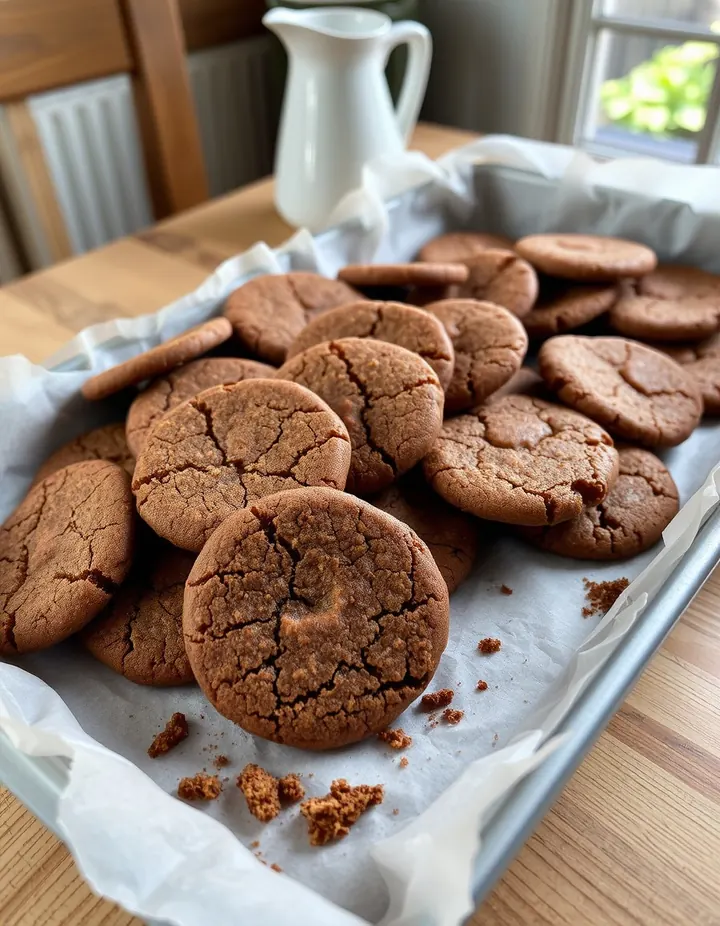 Ginger Cookies213 recipes
 Lemon Ice147 recipes
 Lemon Sherbet103 recipes
The free Flavor Lab newsletter: one surprising pairing a week and the molecular reason it works, in 60 seconds. No spam, unsubscribe anytime.
Prefer an account? Create a free account to save pairings and unlock the full chemistry.