Why it works: Sugar and syrup match in chemistry and in kitchens. They rank in the top 6% of all ingredient pairs, and cooks put them together in 5,842 recipes. Both carry ethanol, which smells alcoholic, ethereal. The science ↓
Jellies of Liqueurs and Spirits
Ingredients
Directions
Make the first jelly
Have, if any, a quart of rather firm calf's foot jelly.
Add, when melted, six liqueur-glassfuls of maresquino and two of brandy.
Pour into your mould.
Set upon ice until firm and ready for use.
When firm, turn out of your mould and serve.
Make the isinglass jelly
If there is no calf's foot jelly, dissolve an ounce and a half of isinglass.
Add it to a syrup made with the juice of two lemons, half a pound of sugar, and a pint of water.
Pass through a napkin or jelly bag.
Add two wineglassfuls more water, with the maresquino and brandy.
When partly cold, place in your mould.
Serve as before.
Make the almond jelly
Blanch and pound in a mortar four ounces of sweet and one ounce of bitter almonds.
Boil three quarters of a pound of sugar to a thickish syrup.
Put in the almonds and let infuse twenty minutes.
Pass through a tammy.
Add sufficient dissolved isinglass or calf's foot jelly to set it.
Add a glass of brandy or rum.
Place the preparation in a bowl upon some ice, keeping it stirred until upon the point of setting.
When set, stir in a pint of cream, previously well whipped.
Pour into a mould.
Let remain upon ice until ready to serve.
Dip into lukewarm water and turn out onto your dish.
Make the pineapple and cream jellies
The flavour of any kind of fruit may be used instead.
Peel a small pineapple and put the rind into a stewpan with six ounces of sugar and two wineglassfuls of water; let boil until reduced to a very thick syrup.
Pass the syrup through a sieve into a basin.
Cut the remainder of the pineapple into very small strips and put into the basin with the syrup.
Boil half a pint of milk, dissolving rather more than an ounce of isinglass.
In another stewpan, whisk the yolks of five eggs, pour the milk over them, mix well, and stir over the fire until it becomes a little thickish but not boiling.
Pass the mixture through a sieve over the syrup, mix well together.
Place in a bowl upon some ice, keep stirring until upon the point of setting.
When set, add three parts of a pint of cream, previously whipped, and stir well in.
Fill your mould and leave upon the ice until ready to serve.
Turn it out as in the last.
Dissolve an ounce and a half of isinglass in a bowl and melt it.
Add six glasses of any liqueur, two of brandy, and six ounces of powdered sugar, letting it dissolve well.
Place the mixture upon some ice, keeping it stirred until upon the point of setting.
When set, add three parts of a pint of whipped cream.
Fill your mould and proceed as before.
Nutrition, whole recipe (rough)
Counts 6 of 8 ingredients. The other 2 aren't in our nutrition table and add nothing above, so the real totals are higher.
What these numbers assume: 6 portions
| Ingredient | Portion assumed | kcal |
|---|---|---|
| Milk | 1 cup (244ml) whole | 149 |
| Egg | 1 large egg (50g) | 78 |
| Cream | 1 tbsp (15ml) heavy | 51 |
| Sugar | 1 tbsp (12.5g) granulated | 49 |
| Lemon | juice of 1 lemon (48ml) | 12 |
| Almond | 1 almond (1.2g) | 7 |
| Water | not in our table | 0 |
| Syrup | not in our table | 0 |
One typical portion per ingredient; the recipe's quantities are not counted. A rough guide only, not for medical or dietary planning.
Transcribed from a scanned cookbook and modernised for today's kitchens. Where the book gave no heat or time, or said "a moderate oven", the temperatures and times here may be modern equivalents rather than the book's own figures. See the original page.
Explore the science
The flavor team
The pairs that carry this dish. Each one is judged two ways: how much their aromas overlap, and how often cooks already put them together.
-
Sugar + syruptop 6% of all pairsSmell alikestrongCooked together5,842 recipes
Shared aroma: ethanol (alcoholic, ethereal).
-
Sugar + creamtop 9% of all pairsSmell alikemoderateCooked together43,450 recipes
Shared aroma: 2,3-butanedione (butter, sweet).
-
Lemon + almondtop 10% of all pairsSmell alikestrongCooked together5,655 recipes
Shared aroma: eucalyptol (eucalyptus, herbal).
-
Syrup + creamtop 12% of all pairsSmell alikemoderateCooked together1,964 recipes
Shared aroma: ethanol (alcoholic, ethereal).
-
Milk + lemontop 15% of all pairsSmell alikemoderateCooked together19,053 recipes
Shared aroma: 2-nonenal (fatty, green).
Ranks compare each pair with 20,000 random ingredient pairs on CompKitchen. How we score pairs
What each ingredient does
- Isinglass
- Gelatine-like protein that sets the liquid into a firm jelly.
- Sugar
- Sweetens the jelly and gives the syrup body.
- Cream
- Adds richness and a soft, airy texture when folded in whipped.
- Eggs
- Yolks thicken the milk into a custard that is stirred into the syrup.
- Almonds
- Infused into the syrup to give a nutty almond flavour.
- Maresquino
- Provides the main flavour and aroma of the jelly.
The step that matters
Stirring over ice until just setting. Chilling while stirring keeps the mixture smooth and evenly set. Cream folded in only at this stage stays aerated and does not sink or separate in the firm jelly.
Swap the lemon
How well each one fits the dish's main ingredients (sugar, syrup, cream, milk, almond, egg):
- Vanillafits better
- Raisinfits better
- Figfits better
- Lemonthe original
Fit is the average pairing score against sugar, syrup, cream, milk, almond, egg. Candidates are from the same food group and used in at least 100 recipes.
“What each ingredient does” and “The step that matters” were written by Claude from this recipe’s own method and reviewed in samples by CompKitchen.
You might also like
 Lemon Cake228 recipes
 Lemon Ice147 recipes
 Lemon Sherbet103 recipes
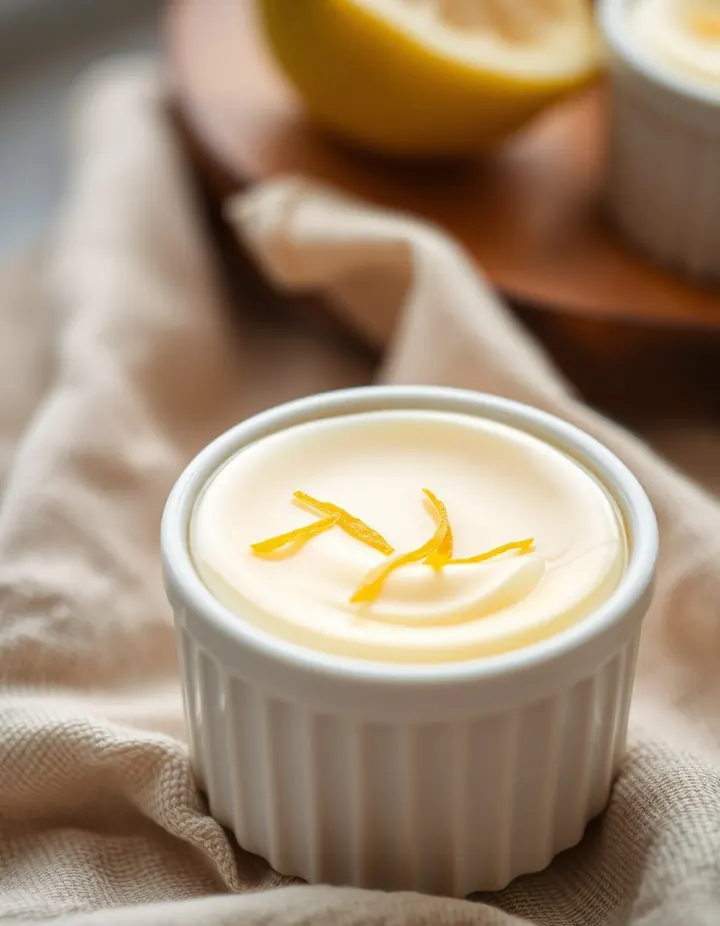 Lemon Custard64 recipes
The free Flavor Lab newsletter: one surprising pairing a week and the molecular reason it works, in 60 seconds. No spam, unsubscribe anytime.
Prefer an account? Create a free account to save pairings and unlock the full chemistry.