Why it works: Cream and lobster match in chemistry and in kitchens. They rank in the top 3% of all ingredient pairs, and 1,050 recipes mention both. Both carry 2,3-butanedione, which smells butter, sweet. The science ↓
The recipe
Ingredients
Contains: egg, milk, wheat, fish, shellfish (auto-detected from the ingredients and method; we can miss things, so check labels)
Directions
Bring the 2 quarts of water to a boil in a large pot with a little salt. Lower in the 3 large or 6 small lobsters and cook until the shells are bright red and the thickest meat is opaque and firm, 145°F (63°C). Cool.
Pick the meat from the lobsters and set the tail pieces and the rest of the meat aside separately. Pound the fins, chine and small claws in a mortar, first removing the brown fin and the head bag.
Put the pounded shell pieces in a pan with the bread crumbs, anchovies, onion, herbs, lemon peel and the lobster cooking water. Simmer gently for about 30 minutes, then strain.
Pound the spawn with the butter, nutmeg and flour. Stir in the cream and milk until smooth, then add this to the strained stock.
Bring the soup to a boil, add the tail pieces, and simmer 2 to 3 minutes until heated through.
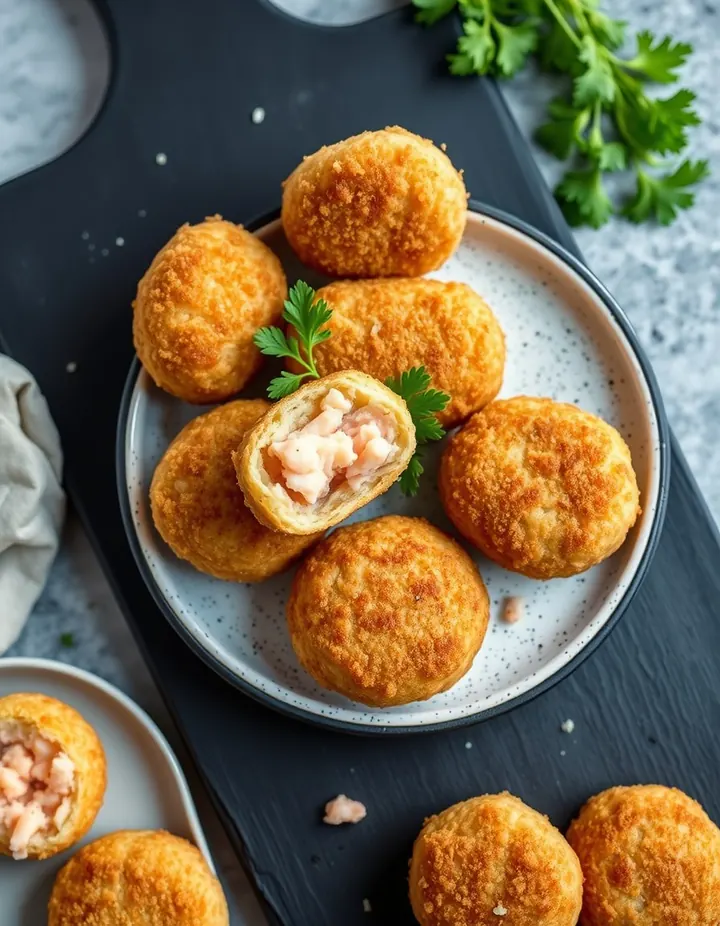
Finely chop the remaining lobster meat. Mix with a little flour, a few bread crumbs, mace, pepper and salt. Moisten with the beaten egg and shape into small balls. Do not taste the raw mixture.
Drop the forcemeat balls into the simmering soup. Cook gently 8 to 10 minutes until firm and an inside piece reaches 160°F (71°C).
Serve hot. Refrigerate any leftover soup within 2 hours and eat within 3 to 4 days.
Original text from the book (10 steps)
_Ingredients._—3 large lobsters, or 6 small ones; the crumb of a French roll, 2 anchovies, 1 onion, 1 small bunch of sweet herbs, 1 strip of lemon-peel, 2 oz. of butter, a little nutmeg, 1 teaspoonful of flour, 1 pint of cream, 1 pint of milk; forcemeat balls, mace, salt, and pepper to taste, bread-crumbs, 1 egg, 2 quarts of water. _Mode._—Pick the meat from the lobsters, and beat the fins, chine, and small claws in a mortar, previously taking away the brown fin and the bag in the head. Put it in a stewpan, with the crumb of the roll, anchovies, onions, herbs, lemon-peel, and the water; simmer gently till all the goodness is extracted, and strain it off. Pound the spawn in a mortar, with the butter, nutmeg, and flour, and mix with it the cream and milk. Give one boil up, at the same time adding the tails cut in pieces. Make the forcemeat balls with the remainder of the lobster, seasoned with mace, pepper, and salt, adding a little flour, and a few bread-crumbs; moisten them with the egg, heat them in the soup, and serve. _Time._—2 hours, or rather more. _Average cost_, 3_s._ 6_d._ per quart. _Seasonable_ from April to October. _Sufficient_ for 8 persons.
LUNCHEONS.
The remains of cold joints, nicely garnished, a few sweets, or a little hashed meat, poultry or game, are the usual articles placed on the table for luncheon, with bread, and cheese, biscuits, butter, &c. If a substantial meal is desired, rump-steaks or mutton chops may be served, as also veal cutlets, kidneys, or any dish of that kind. In families where there is a nursery, the mistress of the house often partakes of the meal with the children, and makes it her luncheon. In the summer, a few dishes of fresh fruit should be added to the luncheon, or, instead of this, a compôte of fruit or fruit tart, or pudding.
MACARONI, as usually served with the CHEESE COURSE.
_Ingredients._—½ lb. of pipe macaroni, 1 lb. of butter, 6 oz. of Parmesan or Cheshire cheese, pepper and salt to taste, 1 pint of milk, 2 pints of water, bread-crumbs. _Mode._—Put the milk and water into a saucepan with sufficient salt to flavour it; place it on the fire, and, when it boils quickly, drop in the macaroni. Keep the water boiling until it is quite tender; drain the macaroni, and put it into a deep dish. Have ready the grated cheese, either Parmesan or Cheshire; sprinkle it amongst the macaroni and some of the butter cut into small pieces, reserving some of the cheese for the top layer. Season with a little pepper, and cover the top layer of cheese with some very fine bread-crumbs. Warm, without oiling, the remainder of the butter, and pour it gently over the bread-crumbs, Place the dish before a bright fire to brown the crumbs; turn it once or twice, that it may be equally coloured, and serve very hot. The top of the macaroni may be browned with a salamander, which is even better than placing it before the fire, as the process is more expeditious; but it should never be browned in the oven, as the butter would oil, and so impart a very disagreeable flavour to the dish. In boiling the macaroni, let it be perfectly tender but firm, no part beginning to melt, and the form entirely preserved. It may be boiled in plain-water, with a little salt instead of using milk, but should then have a small piece of butter mixed with it. _Time._—1 to 1½ hours to boil the macaroni, 5 minutes to brown it before the fire. _Average cost_, 1_s._ 6_d._ _Sufficient_ for 6 or 7 persons. _Seasonable_ at any time.
_Note._—Riband macaroni may be dressed in the same manner, but does not require boiling so long a time.
_Ingredients._—¼ lb. of pipe or riband macaroni, ½ pint of milk, ½ pint of veal or beef gravy, the yolks of 2 eggs, 4 tablespoonfuls of cream, 3 oz. of grated Parmesan or Cheshire cheese, 1 oz. of butter. _Mode._—Wash the macaroni, and boil it in the gravy and milk until quite tender, without being broken. Drain it, and put it into rather a deep dish. Beat the yolks of the eggs with the cream and 2 tablespoonfuls of the liquor the macaroni was boiled in; make this sufficiently hot to thicken, but do not allow it to boil; pour it over the macaroni, over which sprinkle the grated cheese and the butter broken into small pieces; brown with a salamander, or before the fire, and serve. _Time._—1 to 1½ hour to boil the macaroni, 5 minutes to thicken the eggs and cream, 5 minutes to brown. _Average cost_, 1_s._ 2_d._ _Sufficient_ for 3 or 4 persons, _Seasonable_ at any time.
_Ingredients._—¼ lb. of pipe macaroni, ½ pint of brown gravy No. 436, 6 oz. of grated Parmesan cheese. _Mode._—Wash the macaroni, and boil it in salt and water until quite tender; drain it, and put it into rather a deep dish. Have ready a pint of good brown gravy, pour it hot over the macaroni, and send it to table with grated Parmesan served on a separate dish. When the flavour is liked, a little pounded mace may be added to the water in which the macaroni is boiled; but this must always be sparingly added, as it will impart a very strong flavour. _Time._—1 to 1½ hour to boil the macaroni. _Average cost_, with the gravy and cheese, 1_s._ 3_d._ _Sufficient_ for 3 or 4 persons. _Seasonable_ at any time.
MACARONI, Sweet Pudding.
_Ingredients._—2½ oz. of macaroni, 2 pints, of milk, the rind of ½ lemon, 3 eggs, sugar and grated nutmeg to taste, 2 tablespoonfuls of brandy. _Mode._—Put the macaroni, with a pint of the milk, into a saucepan with the lemon-peel, and let it simmer gently until the macaroni is tender: then put it into a pie-dish without the peel; mix the other pint of milk with the eggs; stir these well together, adding the sugar and brandy, and pour the mixture over the macaroni. Grate a little nutmeg over the top, and bake in a moderate oven for ½ hour. To make this pudding look nice, a paste should be laid round the edges of the dish, and, for variety, a layer of preserve or marmalade may be placed on the macaroni: in this case, omit the brandy. _Time._—1 hour to simmer the macaroni; ½ hour to bake the pudding. _Average cost_, 11_d._ _Sufficient_ for 5 or 6 persons. _Seasonable_ at any time.
From a scanned old cookbook. The method has been rewritten by AI to follow current food-safety guidance (safe cooking temperatures, refrigeration, no raw-egg shortcuts). It hasn't been kitchen-tested. The original text is under the method. See the original page.
Found this recipe through an AI assistant? CompKitchen also shows which ingredients go well together and why, from the aroma molecules they share and how often recipes combine them. Try the pairing tools.
Explore the science
The flavor team
The pairs that carry this dish. Each one is judged two ways: how much aroma chemistry they share, and how many recipes mention both.
-
Cream + lobstertop 3% of all pairsAroma overlapstrongMentioned together1,050 recipes
Shared aroma: 2,3-butanedione (butter, sweet).
-
Milk + buttertop 3% of all pairsAroma overlapstrongMentioned together81,222 recipes
Shared aroma: (z)-4-heptenal (biscuit, cream).
-
Cream + buttertop 3% of all pairsAroma overlapstrongMentioned together41,494 recipes
Shared aroma: delta-dodecalactone (sweet, creamy).
-
Flour + buttertop 6% of all pairsAroma overlaplowMentioned together122,858 recipes
Shared aroma: isobutyraldehyde (malty, green).
-
Brandy + buttertop 6% of all pairsAroma overlapstrongMentioned together5,127 recipes
Shared aroma: ethyl octanoate (fruity, wine).
Flour and butter share little aroma chemistry, yet 122,858 recipes mention both: they likely work on texture and structure more than aroma.
Ranks compare each pair with 20,000 random ingredient pairs on CompKitchen. How we score pairs
Flavor stand-ins for the onion
How well each one fits the dish's main ingredients (flour, cream, milk, veal, brandy, butter, lobster):
- Potatobetter flavor fit
- Onionthe original
- Asparagusabout as good a flavor fit
- Capsicumabout as good a flavor fit
Fit is the average pairing score against flour, cream, milk, veal, brandy, butter, lobster. Candidates are from the same food group and used in at least 100 recipes. This compares flavor only: it does not check the job the ingredient does in the dish (bulk, moisture, acidity, structure).
Make it your own
Stand-ins, a drink, and quick taste fixes for this dish, ranked by how well each fits its other ingredients: shared aroma molecules and how often recipes combine them.
You might also like
 Illustration
 Illustration
 Illustration
 Illustration
The Sunday pairing: one pairing, the chemistry behind it, and how to cook it. No spam, unsubscribe anytime.
Prefer an account? Create a free account for sign-in; Pro adds the full results and chemistry.