Why it works: Cream and butter are a kitchen classic. They rank in the top 8% of all ingredient pairs, and cooks put them together in 41,516 recipes. Both carry delta-dodecalactone, which smells sweet, creamy. The science ↓
Brioche Paste
Ingredients
Directions
The _brioche_ is a rich, light kind of unsweetened bun or cake, very commonly sold, and served to all classes of people in France, where it is made in great perfection by good cooks and pastry cooks. It is fashionable now at English tables, though in a different form, serving principally as a crust to enclose _rissoles_, or to make _cannelons_ and fritters. We have seen it recommended for a _vol-au-vent_, for which we should say it does not answer by any means so well as the fine puff-paste called _feuilletage_. The large proportion of butter and eggs which it contains render it to many persons highly indigestible; and we mention this to warn invalids against it, as we have known it to cause great suffering to persons out of health. To make it, take a couple of pounds[114] of fine dry flour, sifted as for cakes, and separate eight ounces of this from the remainder to make the leaven. Put it into a small pan, and mix it lightly into a lithe paste, with half an ounce of yeast, and a spoonful or two of warm water; make two or three slight incisions across the top, throw a cloth over the pan, and place it near the fire for about twenty minutes to rise. In the interval make a hollow space in the centre of the remainder of the flour, and put into it half an ounce of salt, as much fine sifted sugar, and half a gill of cream, or a dessertspoonful of water; add a pound of butter as free from moisture as it can be, and quite so from large grains of salt; cut it into small bits, put it into the flour, and pour on it one by one six fresh eggs freed from the specks; then with the fingers work the flour gently into this mass until the whole forms a perfectly smooth, and not stiff paste: a seventh egg, or the yolk of one, or even of two, may be added with advantage if the flour will absorb them; but the brioche must always be _workable_, and not so moist as to adhere to the board and roller disagreeably. When the leaven is well risen spread this paste out, and the leaven over it;
Footnote 114:
It should be remarked, that the directions for brioche-making are principally derived from the French, and that the pound in their country weighs two ounces more than with us: this difference will account for the difficulty of working in the number of eggs which they generally specify, and which render the paste too moist.
Flour, 2 lbs.; yeast, 1/2 oz.; salt and sugar, each 1/2 oz.; butter, 1 lb.; eggs, 6 to 8.
Nutrition, whole recipe (rough)
What these numbers assume: 5 portions
| Ingredient | Portion assumed | kcal |
|---|---|---|
| Flour | 1 cup (125g) all-purpose | 455 |
| Butter | 1 tbsp (14g) | 102 |
| Eggs | 1 large egg (50g) | 78 |
| Cream | 1 tbsp (15ml) heavy | 51 |
| Salt | 1 tsp (6g) | 0 |
One typical portion per ingredient; the recipe's quantities are not counted. A rough guide only, not for medical or dietary planning.
Transcribed from a scanned cookbook and modernised for today's kitchens. Where the book gave no heat or time, or said "a moderate oven", the temperatures and times here may be modern equivalents rather than the book's own figures. See the original page.
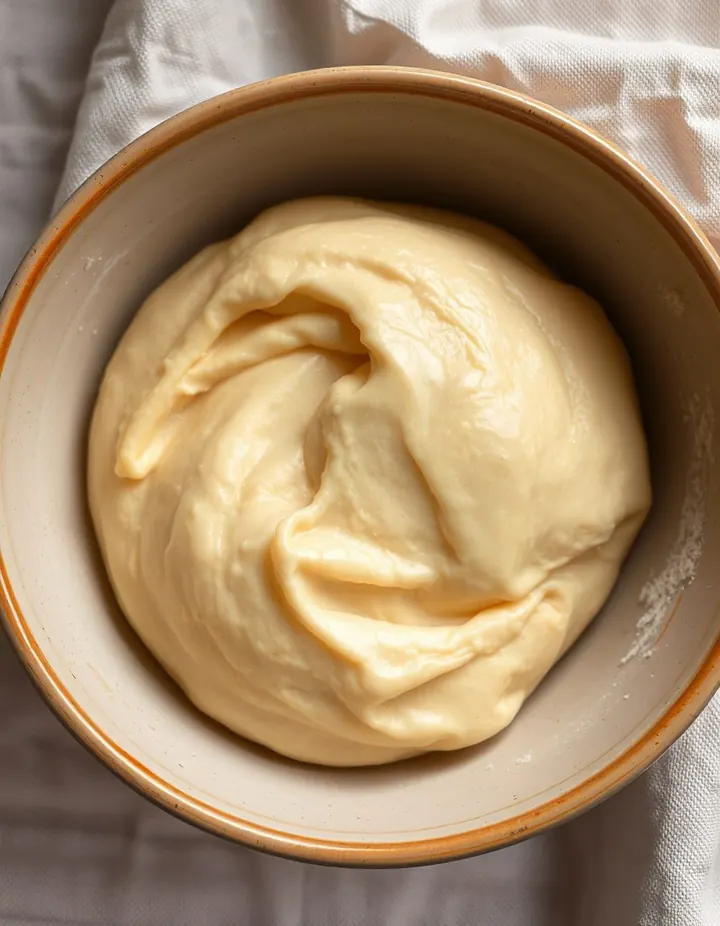
Photo for illustrative purposes only · Contact us to use it
Explore the science
The flavor team
The pairs that carry this dish. Each one is judged two ways: how much their aromas overlap, and how often cooks already put them together.
-
Cream + buttertop 8% of all pairsSmell alikemoderateCooked together41,516 recipes
Shared aroma: delta-dodecalactone (sweet, creamy).
-
Butter + eggtop 17% of all pairsSmell alikemoderateCooked together118,967 recipes
Shared aroma: decanal (soap, orange peel).
-
Cream + eggtop 24% of all pairsSmell alikelowCooked together42,166 recipes
Shared aroma: acetic acid (sour, vinegar).
Cream and egg barely smell alike, yet cooks put them together in 42,166 recipes: they work on texture and structure more than aroma.
Ranks compare each pair with 20,000 random ingredient pairs on CompKitchen. How we score pairs
You might also like
 Tomato Soup526 recipes
 Brown Bread461 recipes
 Mutton Broth292 recipes
 Yorkshire Pudding264 recipes
The free Flavor Lab newsletter: one surprising pairing a week and the molecular reason it works, in 60 seconds. No spam, unsubscribe anytime.
Prefer an account? Create a free account to save pairings and unlock the full chemistry.