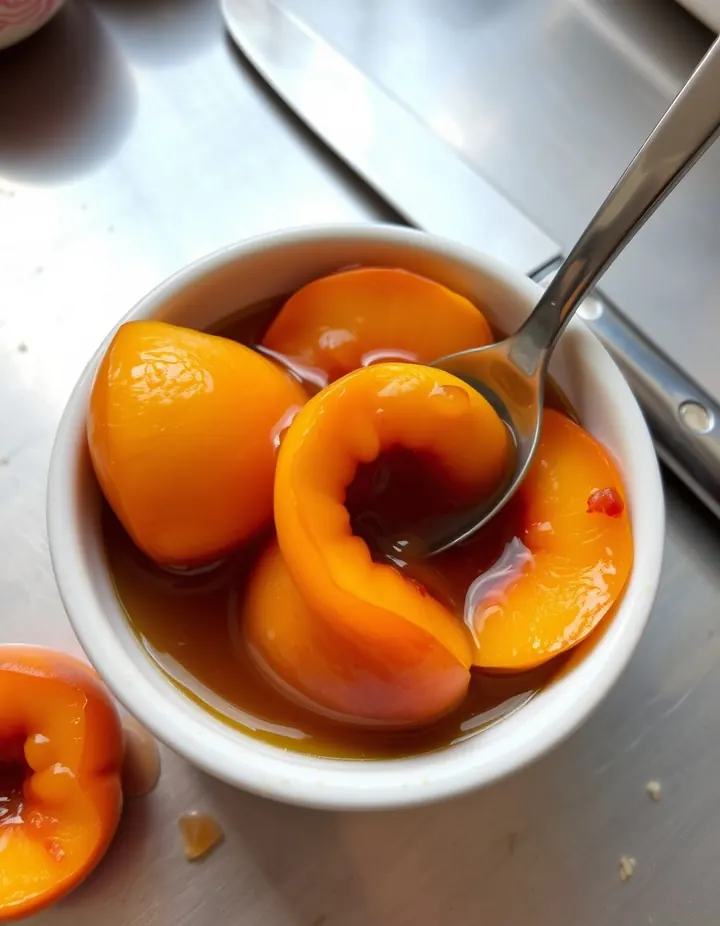
Why it works: Sugar and brandy are a kitchen classic. They rank in the top 19% of all ingredient pairs, and cooks put them together in 11,939 recipes. Both carry beta-damascenone, which smells apple, rose. The science ↓
Brandy Peaches
Ingredients
Directions
Prepare
Take large white or yellow free-stone peaches, the finest you can procure. They must not be too ripe. Rub off the down with a flannel, score them down the seam with a large needle, and prick every peach to the stone in several places.
Scald the peaches with boiling water, and let them remain in the water until it becomes cold, keeping them well covered. Repeat the scalding three times to make them white.
Wipe the peaches and spread them on a soft table-cloth, covering them with several folds. Let them remain in the cloth to dry.
Steep and make the syrup
Put the dried peaches into a tureen or a large jar, and pour on as much white French brandy as will cover them well. Carefully keep the air from them, and let them remain in the brandy for a week.
Make a syrup in the usual manner, allowing to each pound of peaches a pound of loaf-sugar and half a pint of water mixed with a very little beaten white of egg; one white to three or four pounds of sugar.
When the syrup has boiled and been well skimmed, put in the peaches and boil them slowly until they look clear; do not keep them boiling more than half an hour.
Jar and finish
Take the peaches out, drain them, and put them into large glass jars.
Mix the cold syrup with the brandy in which you had the peaches, and pour it over them.
Other methods
Instead of scalding the peaches to whiten them, you may lay them for an hour in sufficient cold weak lye to cover them well, turning them frequently while in the lye, and wipe them dry afterwards.
Another way: after rubbing off the down and pricking them, put them into a preserving kettle with cold water, and simmer them slowly until they become hot all through; but do not allow them to boil. Then dry them in a cloth, and let them lie until they are cold, covering them closely from the air. Dissolve loaf-sugar in the best white brandy (a pound of sugar to a quart of brandy), and having put the peaches into large glass jars, pour the brandy and sugar over them (without boiling) and cover the jars well with leather.
Pears, apricots, and egg plums may also be done in this manner.
Transcribed from a scanned cookbook and modernised for today's kitchens. Where the book gave no heat or time, or said "a moderate oven", the temperatures and times here may be modern equivalents rather than the book's own figures. See the original page.
Photo for illustrative purposes only · Contact us to use it
Explore the science
The flavor team
The pairs that carry this dish. Each one is judged two ways: how much their aromas overlap, and how often cooks already put them together.
-
Sugar + brandytop 19% of all pairsSmell alikelowCooked together11,939 recipes
Shared aroma: beta-damascenone (apple, rose).
Sugar and brandy barely smell alike, yet cooks put them together in 11,939 recipes: they work on texture and structure more than aroma.
Ranks compare each pair with 20,000 random ingredient pairs on CompKitchen. How we score pairs
What each ingredient does
- Peaches (in the method)
- The fruit that softens and turns clear as it cooks gently in the syrup.
- Sugar
- Sweetens the fruit and, as a syrup, draws out water to help preserve it.
- Brandy
- Soaks into the peaches, adding alcohol that helps preserve them and gives flavour.
- Egg white
- Binds impurities in the syrup so they rise and can be skimmed off, leaving it clear.
The step that matters
Boiling the peaches in the syrup. Boiling them slowly and briefly keeps the peaches whole and clear. Prolonged or vigorous boiling softens the fruit until it breaks down and turns mushy.
“What each ingredient does” and “The step that matters” were written by Claude from this recipe’s own method and reviewed in samples by CompKitchen.
You might also like
 Brandy Cream21 recipes
 Brandy Pudding13 recipes
 White Cake431 recipes
 Pound Cake373 recipes
The free Flavor Lab newsletter: one surprising pairing a week and the molecular reason it works, in 60 seconds. No spam, unsubscribe anytime.
Prefer an account? Create a free account to save pairings and unlock the full chemistry.