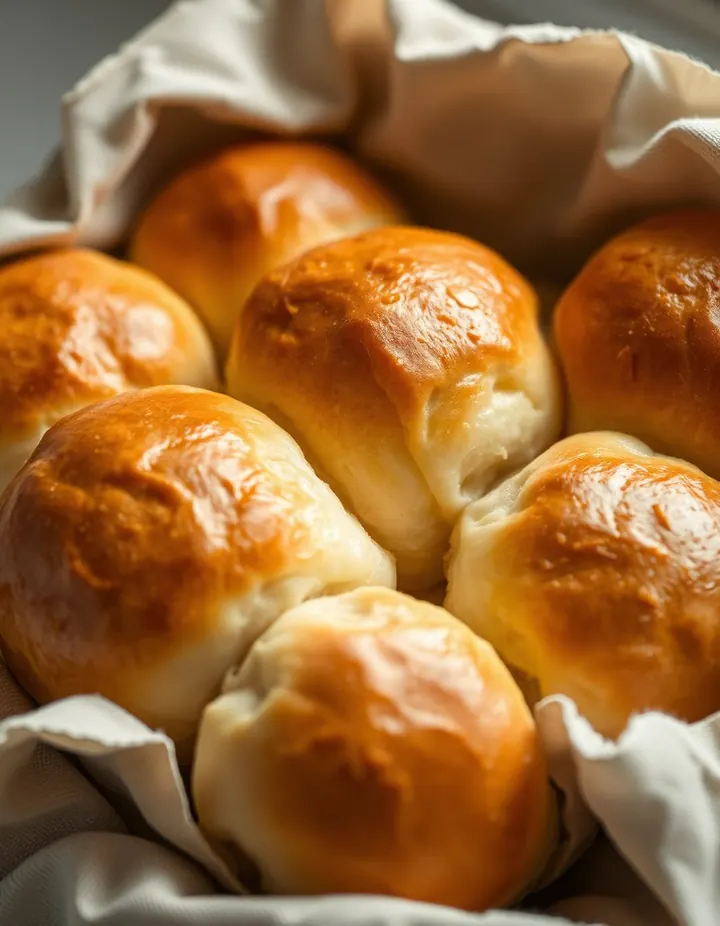
Why it works: Flour and milk are a kitchen classic. They rank in the top 14% of all ingredient pairs, and 78,219 recipes mention both. Both carry isobutyraldehyde, which smells malty, green. The science ↓
Parker House Rolls
Ingredients
Directions
Make the dough
Place the flour in a bowl.
Combine the salt and lard with the milk in a saucepan and warm until the lard melts.
When the milk is lukewarm, add the yeast and pour it into the center of the flour.
Mix to form a thin batter, cover, and leave it in a cool place overnight.
Knead the dough thoroughly and let it rise.
Shape and bake
Roll the dough out to ⅔ inch thick and cut into 4-inch rounds.
Brush half of each round with melted butter, fold over, and shape into rolls.
Place the rolls in buttered pans, let them rise until light, and then bake.
Transcribed from a scanned cookbook and modernised for today's kitchens. Where the book gave no heat or time, or said "a moderate oven", the temperatures and times here may be modern equivalents rather than the book's own figures.
Photo for illustrative purposes only · Contact us to use it
Explore the science
The flavor team
The pairs that carry this dish. Each one is judged two ways: how much aroma chemistry they share, and how many recipes mention both.
-
Flour + milktop 14% of all pairsAroma overlaplowMentioned together78,219 recipes
Shared aroma: isobutyraldehyde (malty, green).
-
Flour + sugartop 15% of all pairsAroma overlapmoderateMentioned together92,116 recipes
Shared aroma: phenylacetaldehyde (hawthorne, honey).
-
Milk + sugartop 18% of all pairsAroma overlaplowMentioned together77,875 recipes
Shared aroma: 2-nonenal (fatty, green).
Flour and milk share little aroma chemistry, yet 78,219 recipes mention both: they likely work on texture and structure more than aroma.
Ranks compare each pair with 20,000 random ingredient pairs on CompKitchen. How we score pairs
What each ingredient does
- Flour
- Forms the gluten network that gives the rolls their structure.
- Yeast
- Produces gas that makes the dough rise and become light.
- Lard
- Adds fat that tenderizes the crumb and softens the texture.
- Milk
- Provides moisture and richness to the dough.
- Sugar
- Feeds the yeast and adds a little sweetness and browning.
The step that matters
Leave the batter in a cool place overnight. Yeast fermentation is slow in cool conditions, so the batter develops flavour and rises gradually. Covering it keeps the surface from drying and forming a crust that would limit rising.
“What each ingredient does” and “The step that matters” were written by Claude from this recipe’s own method and reviewed in samples by CompKitchen.
You might also like
 Tomato Soup526 recipes
 Brown Bread461 recipes
 Mutton Broth292 recipes
 Yorkshire Pudding264 recipes
The Sunday pairing: one pairing, the chemistry behind it, and how to cook it. No spam, unsubscribe anytime.
Prefer an account? Create a free account for sign-in; Pro adds the full results and chemistry.