Why it works: Saffron and lemon match in chemistry and in kitchens. They rank in the top 1% of all ingredient pairs, and cooks put them together in 538 recipes. Both carry eucalyptol, which smells eucalyptus, herbal. The science ↓
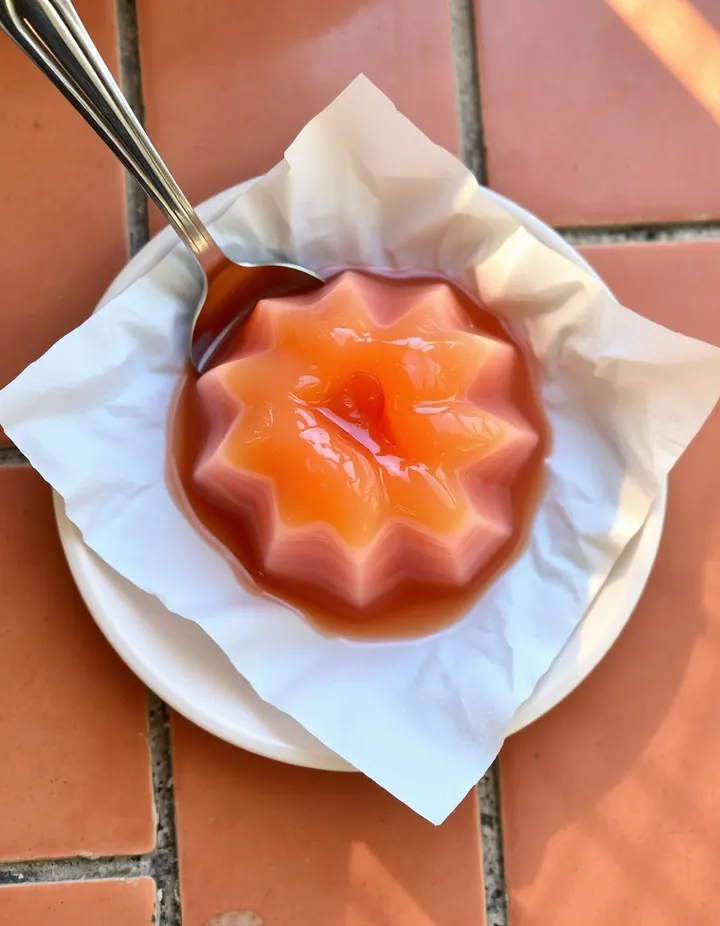
Oriental Jelly
Ingredients
Directions
Prepare
Pour 1 pint of cold water over the gelatine and let it stand for 1 hour.
Drain the juice from the quince and lay the pieces in a napkin.
Add 2 pints of boiling water to the gelatine along with the lemon peel, lemon juice, sugar, and wine; dissolve thoroughly.
Let it stand while the saffron steeps in 1 cup of water for a few minutes.
Remove the lemon peel and divide the jelly into 2 equal parts.
Colour the jelly
If the saffron water is short, make it up with boiling water and add it to one half of the jelly to make it bright yellow.
To the other half, add 1 cup of boiling water and the scoke-berry juice to make it deep red.
Place the jellies on ice until they are stiff enough to hold a heaped tablespoon.
Layer and set
Wet a mould and layer in 2 tablespoons of one color followed by 2 tablespoons of the other, adding a strip of quince in each layer.
Fill the mould and place it on ice immediately.
Transcribed from a scanned cookbook and modernised for today's kitchens. Where the book gave no heat or time, or said "a moderate oven", the temperatures and times here may be modern equivalents rather than the book's own figures.
Explore the science
The flavor team
The pairs that carry this dish. Each one is judged two ways: how much their aromas overlap, and how often cooks already put them together.
-
Saffron + lemontop 1% of all pairsSmell alikestrongCooked together538 recipes
Shared aroma: eucalyptol (eucalyptus, herbal).
-
Sugar + syruptop 6% of all pairsSmell alikestrongCooked together5,842 recipes
Shared aroma: ethanol (alcoholic, ethereal).
-
Berry + lemontop 8% of all pairsSmell alikemoderateCooked together57 recipes
Shared aroma: eucalyptol (eucalyptus, herbal).
-
Lemon + quincetop 11% of all pairsSmell alikestrongCooked together336 recipes
Shared aroma: trans-2-hexenal (green, leafy).
-
Saffron + quincetop 12% of all pairsSmell alikestrongCooked together7 recipes
Shared aroma: acetic acid (sour, vinegar).
Ranks compare each pair with 20,000 random ingredient pairs on CompKitchen. How we score pairs
What each ingredient does
- Gelatine
- Sets the liquid into a firm, sliceable jelly as it cools.
- Sugar
- Adds sweetness and helps give the jelly its body.
- Wine
- Adds flavour and acidity to the jelly.
- Dried saffron flowers
- Gives the jelly its bright yellow colour and a distinctive aroma.
- Lemon juice
- Adds acidity that brightens the flavour and balances the sweetness.
- Canned quince
- Adds fruit pieces and flavour to the layers of the jelly.
The step that matters
Chilling the jellies to the right stiffness before layering. Gelatine sets as it cools. If the halves are too thin, the layers will mix and blur; if they are too stiff, they will not pour or bond cleanly between layers. Testing for a heaped tablespoon helps ensure clean, distinct layers.
Swap the berry
How well each one fits the dish's main ingredients (sugar, wine, saffron, syrup, lemon, quince):
- Orangefits better
- Vanillafits better
- Apricotfits better
- Berrythe original
Fit is the average pairing score against sugar, wine, saffron, syrup, lemon, quince. Candidates are from the same food group and used in at least 100 recipes.
“What each ingredient does” and “The step that matters” were written by Claude from this recipe’s own method and reviewed in samples by CompKitchen.
You might also like
 Lemon Cake228 recipes
 Lemon Ice147 recipes
 Quince Jelly131 recipes
 Lemon Sherbet103 recipes
The free Flavor Lab newsletter: one surprising pairing a week and the molecular reason it works, in 60 seconds. No spam, unsubscribe anytime.
Prefer an account? Create a free account to save pairings and unlock the full chemistry.