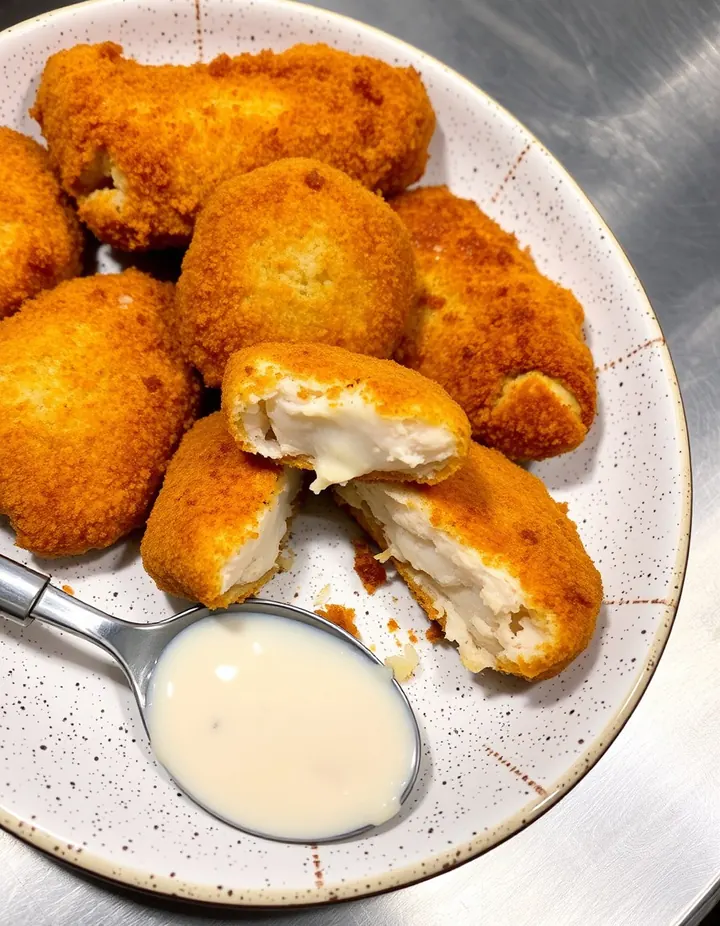
 Illustration
Why it works: Cream and butter match in chemistry and in kitchens. They rank in the top 3% of all ingredient pairs, and 41,494 recipes mention both. Both carry delta-dodecalactone, which smells sweet, creamy. The science ↓
The recipe
Ingredients
Contains: egg, milk, fish (auto-detected from the ingredients and method; we can miss things, so check labels)
Directions
Prepare the fish mixture
Finely chop the halibut and force it through a sieve to measure 1⅓ cups.
Pound the fish in a mortar, gradually adding the egg whites.
Mix in the heavy cream and season with salt, pepper, and cayenne.
Bake and serve
Turn the mixture into buttered cutlet molds.
Place the molds in a pan of hot water, cover with buttered paper, and bake until the fish is firm.
Turn the cutlets onto a serving dish and pour around Dutch Sauce.
Cook to a safe temperature. This method doesn't say how hot the inside should get. Check with a food thermometer in the thickest part:
- Fish: 145°F (63°C), or until the flesh is opaque and flakes easily.
Figures from the USDA's safe minimum internal temperatures.
Transcribed from a scanned cookbook and modernised for today's kitchens. Where the book gave no heat or time, or said "a moderate oven", the temperatures and times here may be modern equivalents rather than the book's own figures.
Found this recipe through an AI assistant? CompKitchen also shows which ingredients go well together and why, from the aroma molecules they share and how often recipes combine them. Try the pairing tools.
The picture is an illustration, not a photo of this recipe · Contact us to use it
Explore the science
The flavor team
The pairs that carry this dish. Each one is judged two ways: how much aroma chemistry they share, and how many recipes mention both.
-
Cream + buttertop 3% of all pairsAroma overlapstrongMentioned together41,494 recipes
Shared aroma: delta-dodecalactone (sweet, creamy).
-
Egg + buttertop 8% of all pairsAroma overlapstrongMentioned together118,511 recipes
Shared aroma: nonanal (fat, citrus).
-
Pepper + buttertop 11% of all pairsAroma overlapstrongMentioned together85,512 recipes
Shared aroma: ethyl octanoate (fruity, wine).
-
Egg + creamtop 12% of all pairsAroma overlapmoderateMentioned together41,958 recipes
Shared aroma: acetic acid (sour, vinegar).
-
Cream + peppertop 13% of all pairsAroma overlaplowMentioned together21,446 recipes
Shared aroma: acetic acid (sour, vinegar).
Cream and pepper share little aroma chemistry, yet 21,446 recipes mention both: they likely work on texture and structure more than aroma.
Ranks compare each pair with 20,000 random ingredient pairs on CompKitchen. How we score pairs
What each ingredient does
- Halibut
- Provides the main body of the cutlet, setting into a firm, tender mass when cooked.
- Egg whites
- Bind the pounded fish and help it set firm and hold its shape when baked.
- Heavy cream
- Adds moisture and richness, keeping the cutlets tender rather than dry.
The step that matters
Baking in a water bath. Baking the molds in a pan of hot water moderates the heat so the egg-bound fish sets gently. Too much heat would overcook and toughen the proteins, making the cutlets rubbery and grainy.
“What each ingredient does” and “The step that matters” were written by Claude, an AI, from this recipe’s own method. They are not checked recipe by recipe, so they can be wrong.
Make it your own
Stand-ins, a drink, and quick taste fixes for this dish, ranked by how well each fits its other ingredients: shared aroma molecules and how often recipes combine them.
You might also like
 Illustration
 Illustration
 Illustration
 Illustration
The Sunday pairing: one pairing, the chemistry behind it, and how to cook it. No spam, unsubscribe anytime.
Prefer an account? Create a free account for sign-in; Pro adds the full results and chemistry.