Why it works: Almond and lemon match in chemistry and in kitchens. They rank in the top 10% of all ingredient pairs, and cooks put them together in 5,655 recipes. Both carry eucalyptol, which smells eucalyptus, herbal. The science ↓
Apple Hedgehog, or Iced Apples
Ingredients
Directions
The book says “a slow oven”. The 300°F (150°C) in the steps is the modern equivalent, not the book's own figure.
Make the apple marmalade
Peel and core the apples without dividing them.
Stew the apples in a tin‑lined saucepan with ½ lb sugar and 1 pint water until tender.
Carefully lift the apples onto a dish.
Core and slice the remaining apples.
Add the sliced apples to the syrup with lemon peel.
Boil gently until reduced to a pulp, stirring to prevent burning.
Build the hedgehog
Cover the bottom of a dish with some of the apple marmalade.
Layer the whole apples on top, filling the cavities with more marmalade.
Repeat layering to form a raised oval shape.
Ice and decorate
Whip the egg whites to a stiff froth.
Mix the whipped egg whites with the pounded sugar.
Cover the apples smoothly with the icing.
Blanch the almonds, then cut the almonds into strips.
Stick them upright at equal distances over the icing to resemble a hedgehog's spines.
Place the dish in a 300°F (150°C) oven for a few minutes before serving.
Transcribed from a scanned cookbook and modernised for today's kitchens. Where the book gave no heat or time, or said "a moderate oven", the temperatures and times here may be modern equivalents rather than the book's own figures.
Explore the science
The flavor team
The pairs that carry this dish. Each one is judged two ways: how much their aromas overlap, and how often cooks already put them together.
-
Almond + lemontop 10% of all pairsSmell alikestrongCooked together5,655 recipes
Shared aroma: eucalyptol (eucalyptus, herbal).
-
Apple + lemontop 14% of all pairsSmell alikemoderateCooked together7,551 recipes
Shared aroma: trans-2-nonenal (cardboard, fatty).
-
Apple + almondtop 15% of all pairsSmell alikemoderateCooked together1,025 recipes
Shared aroma: 2,4-decadienal (seaweed).
-
Sugar + almondtop 18% of all pairsSmell alikemoderateCooked together15,679 recipes
Shared aroma: 1-penten-3-one (fish, pungent).
-
Apple + sugartop 18% of all pairsSmell alikelowCooked together16,478 recipes
Shared aroma: beta-damascenone (apple, rose).
Apple and sugar barely smell alike, yet cooks put them together in 16,478 recipes: they work on texture and structure more than aroma.
Ranks compare each pair with 20,000 random ingredient pairs on CompKitchen. How we score pairs
What each ingredient does
- Cooking apples
- Provide the bulk of the body, cooking down into the soft pulp that holds the shape.
- Sugar
- Sweetens the apple pulp and helps it thicken into a syrupy marmalade.
- Egg whites
- Whipped into a stiff froth to form the white icing that coats the apples.
- Pounded sugar
- Sweetens the whipped egg whites and stabilises them into a smooth icing.
The step that matters
Whip the egg whites to a stiff froth. Egg whites must be fully whipped to hold air; under-whipped whites produce a runny icing that will not stay on the apples or hold the almond spines upright.
Swap the apple
How well each one fits the dish's main ingredients (sugar, almond, lemon, egg):
- Vanillafits better
- Orangefits better
- Raisinfits better
- Applethe original
Fit is the average pairing score against sugar, almond, lemon, egg. Candidates are from the same food group and used in at least 100 recipes.
“What each ingredient does” and “The step that matters” were written by Claude from this recipe’s own method and reviewed in samples by CompKitchen.
You might also like
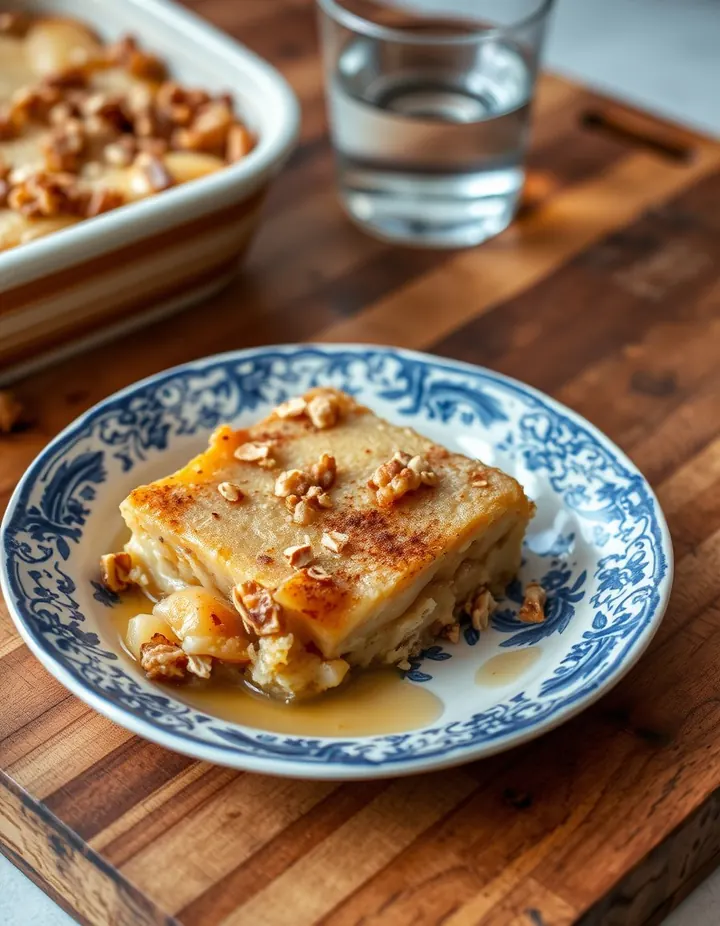 Apple Pudding256 recipes
 Lemon Cake228 recipes
 Lemon Ice147 recipes
 Lemon Sherbet103 recipes
The free Flavor Lab newsletter: one surprising pairing a week and the molecular reason it works, in 60 seconds. No spam, unsubscribe anytime.
Prefer an account? Create a free account to save pairings and unlock the full chemistry.