Why it works: Milk and dock work together. They rank in the top 29% of all ingredient pairs, and cooks put them together in 18 recipes. Both carry 2-methylbutyraldehyde, which smells malty, chocolate. The science ↓
Cream Cheese
Ingredients
Directions
Make the curd
Pour the strippings into a pan and add the rennet.
When the curd forms, break it down gently with a skimmer.
Let it stand for 2 hours, then place a cheesecloth on a sieve and pour the curd onto it to drain the whey.
Press and ripen
Break the curd slightly with your hand and transfer it to a vat, placing a 2-pound weight on top.
Let it sit for 12 hours, then remove it and bind it with a fillet.
Turn the cheese daily until dry, covering it with nettles or dock leaves, and place it between two pewter plates to ripen.
If the weather is warm, it will be ready in 3 weeks.
Transcribed from a scanned cookbook and modernised for today's kitchens. Where the book gave no heat or time, or said "a moderate oven", the temperatures and times here may be modern equivalents rather than the book's own figures.
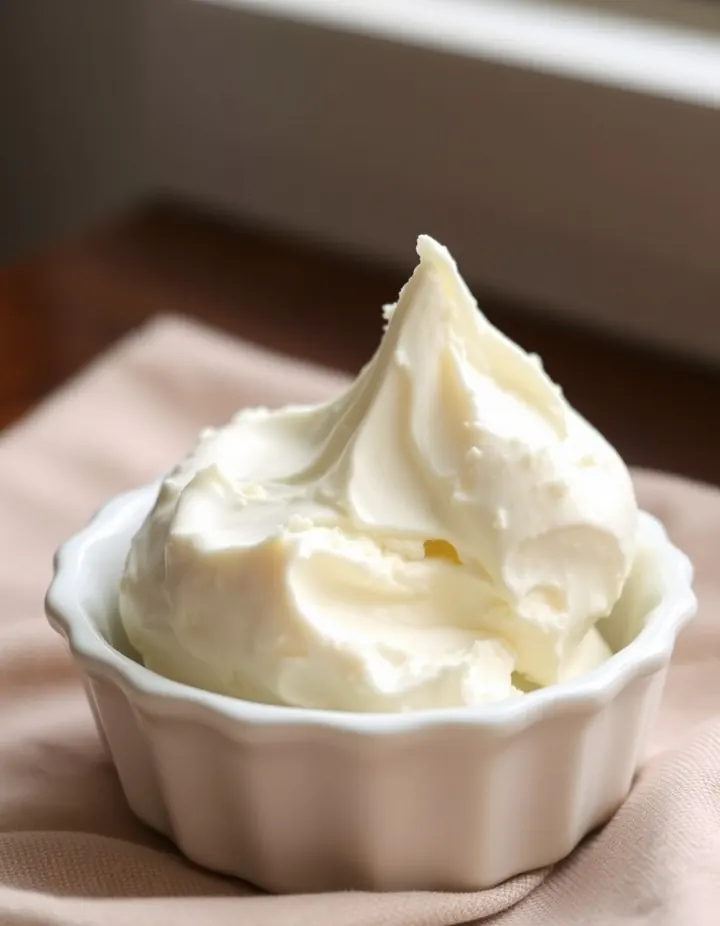
Photo for illustrative purposes only · Contact us to use it
Explore the science
The flavor team
The pairs that carry this dish. Each one is judged two ways: how much their aromas overlap, and how often cooks already put them together.
-
Milk + docktop 29% of all pairsSmell alikemoderateCooked together18 recipes
Shared aroma: 2-methylbutyraldehyde (malty, chocolate).
Ranks compare each pair with 20,000 random ingredient pairs on CompKitchen. How we score pairs
What each ingredient does
- Strippings
- Provide the milk that rennet coagulates into curd, forming the cheese body.
- Rennet
- Enzyme that coagulates the milk proteins, setting the curd so it can be separated from the whey.
- Coarse sea salt
- Seasons the cheese and helps draw out moisture as it dries and ripens.
The step that matters
Breaking the curd gently. Cutting or breaking the curd too roughly tears it into small pieces that lose moisture and whey unevenly, while gentle handling keeps larger curds that drain and firm more evenly.
“What each ingredient does” and “The step that matters” were written by Claude from this recipe’s own method and reviewed in samples by CompKitchen.
More cream cheese recipes
You might also like
 Tomato Soup526 recipes
 Brown Bread461 recipes
 Mutton Broth292 recipes
 Yorkshire Pudding264 recipes
The free Flavor Lab newsletter: one surprising pairing a week and the molecular reason it works, in 60 seconds. No spam, unsubscribe anytime.
Prefer an account? Create a free account to save pairings and unlock the full chemistry.