Why it works: Orange and lemon match in chemistry and in kitchens. They rank in the top 1% of all ingredient pairs, and cooks put them together in 10,634 recipes. Both carry 3-hexenal, which smells apple, fruity. The science ↓
To Preserve Oranges or Lemons in Jelly
Ingredients
Directions
Prepare the fruit
Cut a hole in the stalk end of each orange or lemon, the size of a shilling, and scrape out the pulp without cutting the rind.
Tie each fruit in muslin and soak in spring water for two days, changing the water twice a day.
Boil the fruit in fresh water until tender over low heat.
Make the syrup
Weigh two pounds of double-refined sugar and one pint of water for every pound of fruit.
Boil the sugar and water with the juice of the fruit to make a syrup.
Clarify the syrup by skimming it and let it cool.
Boil the fruit in the syrup for half an hour.
If the syrup is not clear, repeat the boiling daily until clear.
Make the apple jelly
Pare and core some green pippins.
Boil the pippins in water until the water tastes strong of the apples.
Strain the pippins through a jelly bag until clear.
Add one pound of double-refined sugar, the peel, and juice of a lemon to each pint of strained apple water.
Boil the mixture to a strong syrup.
Pot and seal
Drain the syrup from the fruit.
Place each orange or lemon hole-up in a jar.
Pour the apple jelly over them.
Cover the jar with brandy-paper.
Transcribed from a scanned cookbook and modernised for today's kitchens. Where the book gave no heat or time, or said "a moderate oven", the temperatures and times here may be modern equivalents rather than the book's own figures.
Explore the science
The flavor team
The pairs that carry this dish. Each one is judged two ways: how much their aromas overlap, and how often cooks already put them together.
-
Orange + lemontop 1% of all pairsSmell alikestrongCooked together10,634 recipes
Shared aroma: 3-hexenal (apple, fruity).
-
Orange + appletop 7% of all pairsSmell alikestrongCooked together2,230 recipes
Shared aroma: beta-damascenone (apple, rose).
-
Apple + brandytop 11% of all pairsSmell alikemoderateCooked together1,291 recipes
Shared aroma: beta-damascenone (apple, rose).
-
Apple + lemontop 14% of all pairsSmell alikemoderateCooked together7,551 recipes
Shared aroma: trans-2-nonenal (cardboard, fatty).
-
Orange + brandytop 15% of all pairsSmell alikelowCooked together2,706 recipes
Shared aroma: beta-damascenone (apple, rose).
Ranks compare each pair with 20,000 random ingredient pairs on CompKitchen. How we score pairs
What each ingredient does
- Oranges or lemons
- Provide the main fruit, whose peel and pulp are preserved whole in the jelly.
- Double-refined sugar
- Sweetens the syrup and, at high concentration, helps preserve the fruit and set the jelly.
- Green pippins
- Supply natural pectin and tartness so the apple water helps the jelly set.
- Lemon juice
- Adds acidity that brightens flavour and supports pectin setting in the jelly.
The step that matters
Clarifying the syrup. Skimming and repeated boiling remove impurities and foam that would cloud the syrup. A clear syrup needs careful skimming and patience, since cloudiness left in the jelly is hard to fix later.
Swap the lemon
How well each one fits the dish's main ingredients (orange, sugar, apple, brandy):
- Apricotfits better
- Vanillafits better
- Pearfits better
- Lemonthe original
Fit is the average pairing score against orange, sugar, apple, brandy. Candidates are from the same food group and used in at least 100 recipes.
“What each ingredient does” and “The step that matters” were written by Claude from this recipe’s own method and reviewed in samples by CompKitchen.
You might also like
 Orange Bundt Cake349 recipes
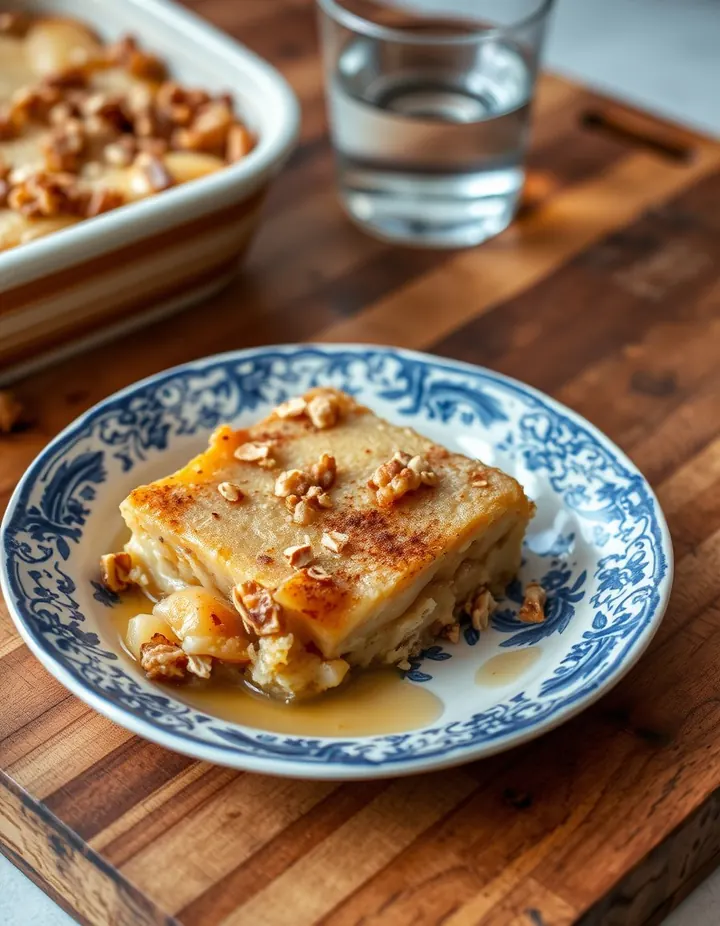 Apple Pudding256 recipes
 Lemon Cake228 recipes
 Lemon Ice147 recipes
The free Flavor Lab newsletter: one surprising pairing a week and the molecular reason it works, in 60 seconds. No spam, unsubscribe anytime.
Prefer an account? Create a free account to save pairings and unlock the full chemistry.