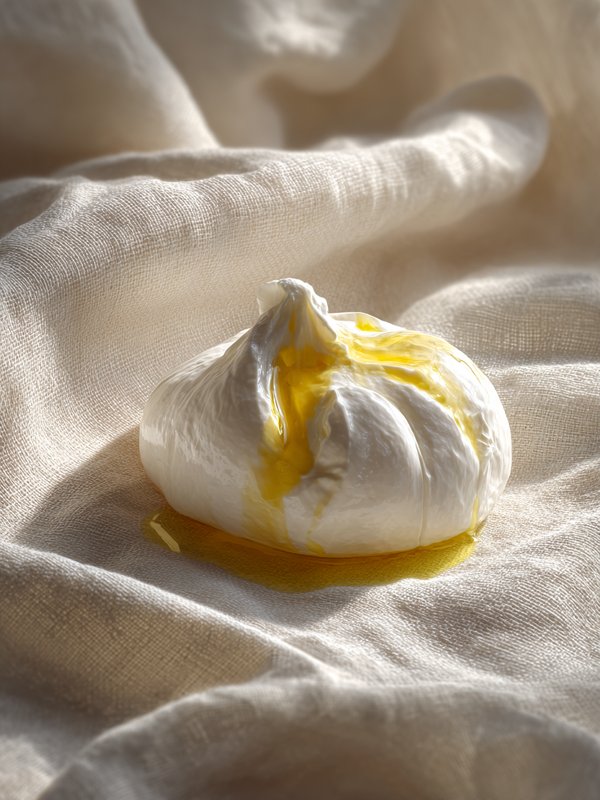
Burrata is a dairy whose aroma is led by delta-dodecalactone (sweet, creamy) and delta-decalactone (sweet, creamy). Cooks pair it most with olive, cheese and pepper. By shared aroma its closest partners are egg, mozzarella cheese and prosciutto.
What goes with burrata
The classics
- Olive: mentioned together in 33 recipes, with moderate shared aroma, including ethyl butyrate (apple, fruity).
- Cheese: mentioned together in 28 recipes, with moderate shared aroma, including delta-dodecalactone (sweet, creamy).
- Pepper: mentioned together in 24 recipes, though they share little aroma: this one is a cooking habit more than a chemical match.
- Tomato: mentioned together in 18 recipes, though they share little aroma: this one is a cooking habit more than a chemical match.
- Basil: mentioned together in 17 recipes, though they share little aroma: this one is a cooking habit more than a chemical match.
Worth trying
- Peach: a top 7% pair that only 7 recipes in our collection use.
- Parmesan cheese: a top 10% pair that only 5 recipes in our collection use.
A hidden gem is a lead to test, not a proven pairing: strong shared chemistry, but cooks have barely tried it.
Burrata pairing chart
Scroll sideways to see every column →
| Partner | Shared aroma | Shared molecules | Recipes together | Rank among all pairs |
|---|---|---|---|---|
| cheese | moderate | 23 | 28 | top 4% |
| mozzarella cheese | strong | 18 | 8 | top 5% |
| vinegar | low | 13 | 16 | top 6% |
| peach | moderate | 17 | 7 | top 7% |
| olive | moderate | 17 | 33 | top 7% |
| arugula | low | 0 | 14 | top 8% |
| tomato | low | 20 | 18 | top 8% |
| basil | low | 12 | 17 | top 8% |
| parmesan cheese | moderate | 17 | 5 | top 10% |
| butter | moderate | 18 | 5 | top 11% |
| fig | moderate | 18 | 3 | top 11% |
| cherry | moderate | 18 | 7 | top 16% |
| prosciutto | strong | 9 | 4 | top 16% |
| garlic | low | 13 | 17 | top 16% |
| lemon | low | 13 | 8 | top 17% |
| peas | low | 9 | 2 | top 18% |
| honey | low | 18 | 2 | top 18% |
| cream | strong | 14 | 0 | top 18% |
| brioche | strong | 13 | 0 | top 19% |
| onion | moderate | 17 | 9 | top 19% |
Ordered by pairing score. Shared aroma: how much of their aroma chemistry overlaps (strong, moderate or low against all ingredient pairs). Rank: where the pair sits among random ingredient pairs on CompKitchen. Shared molecules counts every molecule the two have in common, not only aroma ones. Each partner links to a side-by-side comparison.
Burrata flavor profile
Burrata carries 25 flavor molecules in our data, 23 of them volatile enough to smell and 20 of them key food odorants, the molecules shown to drive food aroma. The aromas that lead its profile, strongest measured first: delta-dodecalactone (sweet, creamy), delta-decalactone (sweet, creamy), ethyl butyrate (apple, fruity) and gamma-decalactone (peach, creamy).
Why burrata pairs the way it does
Burrata's pairing hooks are acetic acid (sour, vinegar), which 7 of its 10 best partners also carry but only 17% of all ingredients do; and gamma-decalactone (peach, creamy), which 5 of its 10 best partners also carry but only 8% of all ingredients do. Partners that share them, like cheese, mozzarella cheese and vinegar, share more with burrata than the background chemistry most foods carry. Partners that share little aroma, like pepper and tomato, pair through cooking habit instead: 24 and 18 recipes respectively.
How cooks use burrata
Key aroma molecules in burrata
Scroll sideways to see every column →
| Molecule | Smells like | Why it matters |
|---|---|---|
| delta-dodecalactone | sweet, creamy, fruity | In 19 of 861 ingredients; a key food odorant. Shared with cheese, peach and butter. |
| delta-decalactone | sweet, creamy, coconut | In 31 of 861 ingredients; a key food odorant. Shared with cheese, peach and butter. |
| ethyl butyrate | apple, fruity, sweet | In 134 of 861 ingredients; a key food odorant. Shared with cheese, mozzarella cheese and olive. |
| gamma-decalactone | peach, creamy, coconut | In 65 of 861 ingredients; a key food odorant. Shared with cheese, mozzarella cheese and peach. |
| ethyl caproate | fruity, apple peel, pineapple | In 142 of 861 ingredients; a key food odorant. Shared with cheese, mozzarella cheese and tomato. |
| dimethyl sulfide | cabbage, sulfurous, cooked corn | In 181 of 861 ingredients; a key food odorant. Shared with cheese, mozzarella cheese and olive. |
| butanoic acid | rancid, cheesy, sweaty | In 100 of 861 ingredients; a key food odorant. Shared with cheese, vinegar and olive. |
| 2-undecanone | waxy, fruity, fresh | In 110 of 861 ingredients. Shared with cheese, mozzarella cheese and peach. |
Ordered by measured strength in burrata (concentration against odour threshold) where studies report it, then by how rare the molecule is across foods. Smell words are each molecule's own published description. Key food odorants are the molecules shown to drive food aroma (Dunkel et al. 2014).
Does it go with what you have?
ButterSometimes
Mentioned together in 5 recipes, moderate shared aroma, top 11% of pairs. They share delta-dodecalactone (sweet, creamy). Compare →
LemonHabit
Mentioned together in 8 recipes, low shared aroma, top 17% of pairs. Compare →
GarlicHabit
Mentioned together in 17 recipes, low shared aroma, top 16% of pairs. Compare →
SugarHabit
Mentioned together in 10 recipes, low shared aroma, top 25% of pairs. Compare →
ChiliSometimes
Mentioned together in 6 recipes, low shared aroma, top 25% of pairs. Compare →
GingerUntested
No recipe in our pairing index uses both, low shared aroma, bottom 20% of pairs. Compare →
Burrata pairing questions
What makes burrata smell like burrata?
Its leading aroma molecules are delta-dodecalactone (sweet, creamy), delta-decalactone (sweet, creamy) and ethyl butyrate (apple, fruity), out of the 23 aroma molecules on record for it.
What's a good substitute for burrata?
The closest molecular substitutes for burrata are halloumi, cream, brie — ingredients that share the highest fraction of burrata's flavor compounds.
Is burrata vegan, gluten-free, or kosher?
Burrata is vegetarian (not vegan) and is gluten-free, nut-free, kosher, halal. Allergen tags: milk.
The science in full
Origin: Kyrgyzstan, Italy. Wikidata Q543512 (CC0)
All 25 molecules on record
4 of 25 are distinctive to burrata (in under 10% of foods). Ordered by measured impact in burrata, then by how distinctive the molecule is.
87 research papers on burrata
- Effect of Lactiplantibacillus plantarum and Carnobacterium spp. on the sensory quality of Burrata cheese during storage: a multi-technique study. Food research international (Ottawa, Ont.) · 2026
- Microencapsulation of Probiotics for Enhanced Stability and Health Benefits in Dairy Functional Foods: A Focus on Pasta Filata Cheese. · 2025
- Development of Innovative Vitamin D Enrichment Designs for Two Typical Italian Fresh Cheeses: Burrata and Giuncata. Molecules (Basel, Switzerland) · 2023
- Application of Commercial Biopreservation Starter in Combination with MAP for Shelf-Life Extension of Burrata Cheese. · 2023
- An Overview of Antimicrobial Activity of Lysozyme and Its Functionality in Cheese. · 2022
Explore more: pair it · find substitutes · discover novel pairings · get this data via the API · how we score pairs