Why it works: Milk and butter are a kitchen classic. They rank in the top 7% of all ingredient pairs, and cooks put them together in 81,283 recipes. Both carry (z)-4-heptenal, which smells biscuit, cream. The science ↓
Lemon Honey Cake
Ingredients
Directions
Make the cake
Rub the butter and sugar to a cream.
Add the milk.
Add the whites of eight eggs beaten to a stiff froth.
Add the corn starch and flour, to which the baking powder has been added.
Bake in jelly tins.
Make the lemon filling
Put the sugar, lemon and butter into a saucepan and melt over a gentle fire.
When all is dissolved, stir in the eggs which have been well beaten.
Stir rapidly until it is as thick as honey.
Fill and store
Spread this between the layers of cake.
Set aside the remainder in a closely covered vessel for future use.
Nutrition, whole recipe (rough)
What these numbers assume: 6 portions
| Ingredient | Portion assumed | kcal |
|---|---|---|
| Flour | 1 cup (125g) all-purpose | 455 |
| Milk | 1 cup (244ml) whole | 149 |
| Butter | 1 tbsp (14g) | 102 |
| Egg | 1 large egg (50g) | 78 |
| Sugar | 1 tbsp (12.5g) granulated | 49 |
| Lemon | juice of 1 lemon (48ml) | 12 |
One typical portion per ingredient; the recipe's quantities are not counted. A rough guide only, not for medical or dietary planning.
Transcribed from a scanned cookbook and modernised for today's kitchens. Where the book gave no heat or time, or said "a moderate oven", the temperatures and times here may be modern equivalents rather than the book's own figures. See the original page.
Explore the science
The flavor team
The pairs that carry this dish. Each one is judged two ways: how much their aromas overlap, and how often cooks already put them together.
-
Milk + buttertop 7% of all pairsSmell alikemoderateCooked together81,283 recipes
Shared aroma: (z)-4-heptenal (biscuit, cream).
-
Milk + corntop 10% of all pairsSmell alikemoderateCooked together6,955 recipes
Shared aroma: hexanal (green, grassy).
-
Flour + buttertop 12% of all pairsSmell alikelowCooked together124,287 recipes
Shared aroma: isobutyraldehyde (malty, green).
-
Corn + flourtop 13% of all pairsSmell alikemoderateCooked together6,165 recipes
Shared aroma: isobutyraldehyde (malty, green).
-
Corn + lemontop 13% of all pairsSmell alikemoderateCooked together1,927 recipes
Shared aroma: 2-nonenal (fatty, green).
Flour and butter barely smell alike, yet cooks put them together in 124,287 recipes: they work on texture and structure more than aroma.
Ranks compare each pair with 20,000 random ingredient pairs on CompKitchen. How we score pairs
What each ingredient does
- Eggs
- Whites trap air for lift, and beaten yolks and whole eggs help set the batter and filling.
- Butter
- Creams with the sugar to give the cake a tender, rich crumb and adds richness to the filling.
- Flour
- Provides the main structure that holds the cake together as it bakes.
- Baking powder
- Releases gas during baking so the cake rises and becomes light.
- Sugar
- Sweetens the cake and, creamed with butter, helps give a soft texture.
- Lemons
- Adds bright acidity and aroma that cut the sweetness of the filling.
The step that matters
Stir in the beaten eggs. Beaten eggs can scramble when they meet the hot sugar, lemon and butter mixture. Stir them in steadily while the mixture is over the gentle heat, and keep stirring as it thickens so the filling stays smooth.
Swap the lemon
How well each one fits the dish's main ingredients (sugar, milk, corn, flour, butter, egg):
- Vanillafits better
- Raisinfits better
- Coconutfits better
- Lemonthe original
Fit is the average pairing score against sugar, milk, corn, flour, butter, egg. Candidates are from the same food group and used in at least 100 recipes.
“What each ingredient does” and “The step that matters” were written by Claude from this recipe’s own method and reviewed in samples by CompKitchen.
You might also like
 Lemon Cake228 recipes
 Lemon Ice147 recipes
 Lemon Sherbet103 recipes
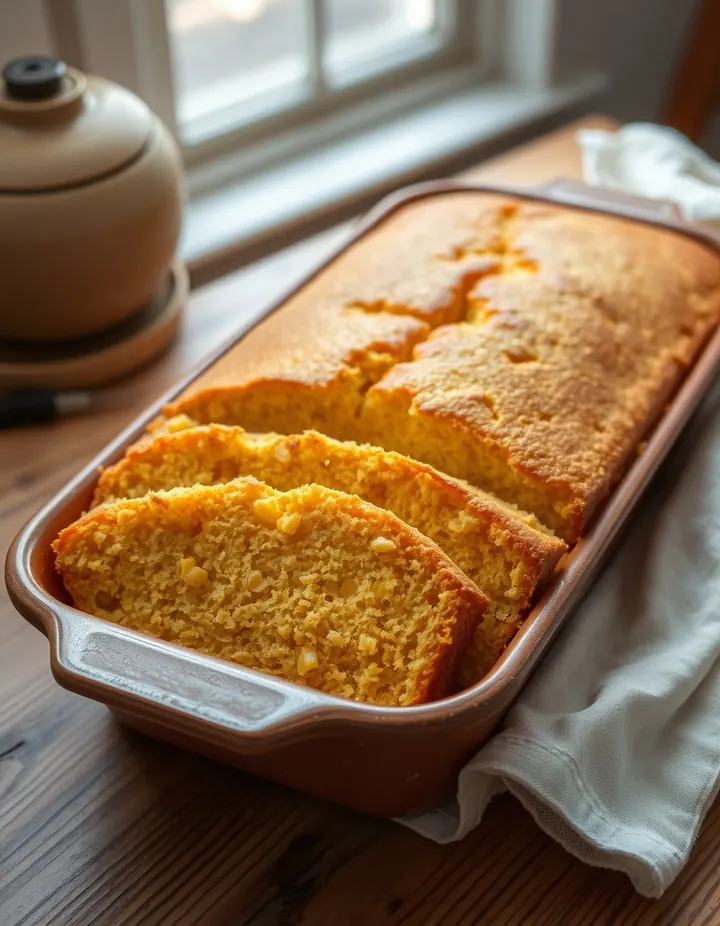 Corn Cake90 recipes
The free Flavor Lab newsletter: one surprising pairing a week and the molecular reason it works, in 60 seconds. No spam, unsubscribe anytime.
Prefer an account? Create a free account to save pairings and unlock the full chemistry.