Why it works: Butter and gin work together. They rank in the top 29% of all ingredient pairs, and 31 recipes mention both. Both carry nonanal, which smells fat, citrus. The science ↓
The recipe
Ingredients
Contains: egg, milk, wheat (auto-detected from the ingredients and method; we can miss things, so check labels)
Also mentioned in the method: flour
Directions
Make the gingerbread dough
Take half a pint of molasses, a small cup of soft butter, a gill and a half of water, a heaping teaspoon of soda dissolved in a tablespoon of hot water, and one even tablespoon of strong ginger, or two if weak.
Knead butter and ginger into the flour.
Add the water, soda, and molasses. While doing it, put in two tablespoons of vinegar.
Add two beaten eggs to the above mixture.
Add water to make it thin as a pound-cake.
Bake as soon as well mixed.
Mix one cup of butter, two cups of sugar or molasses, one cup of water, one tablespoon of ginger, one heaping teaspoon of cinnamon, one of cloves, and one teaspoon of soda dissolved in a small cup of hot water.
Add flour for a stiff dough.
Shape and bake
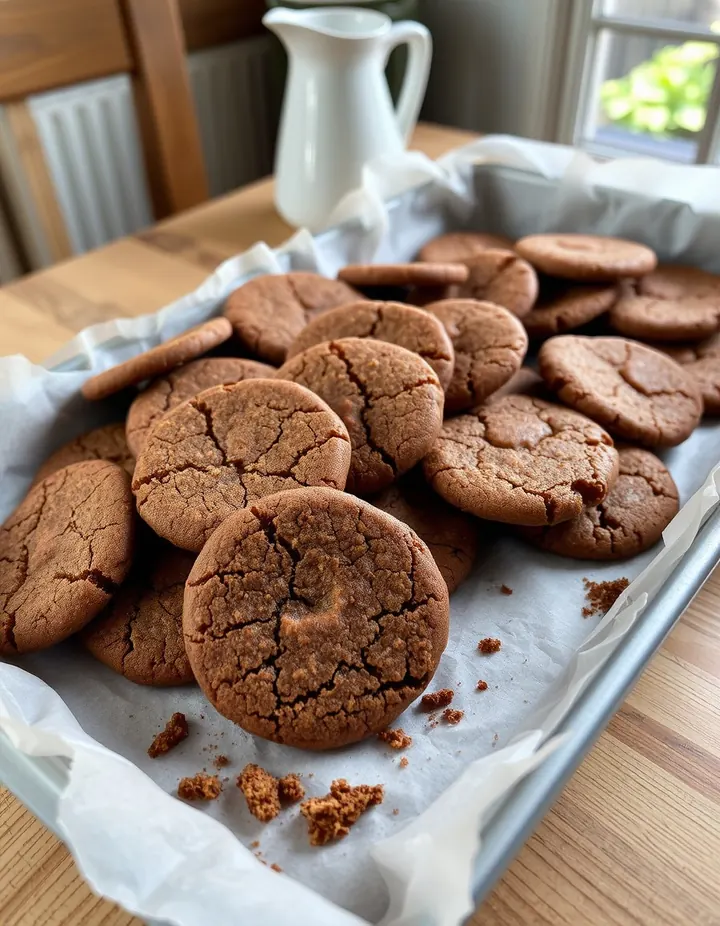
Roll the dough into cakes an inch thick.
Roll and cut into small round cakes.
Bake half an hour in a quick oven.
Omit the spices, and add four or five tablespoons of caraway seeds, and you have seed-cakes.
Leave out all spice and seeds, and you have plain cookies.
For doughnuts, use the recipe for plain sponge cake, add enough flour to roll.
Or take plain cake raised with eggs, and add enough flour to roll.
Or take dough cake, or plain loaf cake, and thicken so as to roll.
Roll about half an inch thick and cut into oblong pieces.
For crullers, take plain cake raised with eggs, and thicken stiff with flour.
Roll it thin, cut into strips, and form twisted cakes.
More sugar and butter make it richer, but less healthful.
Fry
Have plenty of lard, or better, strained beef-fat, quite hot; try with a small piece first, and if right, there will be a bubbling.
Turn two or three times to cook all alike.
Break open one to try if done.
When done, take up with a skimmer and drain well.
If the fat is too hot, it will brown too quick.
If not hot enough, the fat will soak into the cake.
Remember that frying is the most unhealthful mode of cooking food, and the one most likely to be done amiss.
Transcribed from a scanned cookbook and modernised for today's kitchens. Where the book gave no heat or time, or said "a moderate oven", the temperatures and times here may be modern equivalents rather than the book's own figures. See the original page.
Found this recipe through an AI assistant? CompKitchen also shows which ingredients go well together and why, from the aroma molecules they share and how often recipes combine them. Try the pairing tools.
Explore the science
The flavor team
The pairs that carry this dish. Each one is judged two ways: how much aroma chemistry they share, and how many recipes mention both.
-
Butter + gintop 29% of all pairsAroma overlapmoderateMentioned together31 recipes
Shared aroma: nonanal (fat, citrus).
-
Ginger + teatop 3% of all pairsAroma overlapstrongMentioned together216 recipes
Shared aroma: isoamyl acetate (banana, pear).
-
Sugar + molassestop 6% of all pairsAroma overlapmoderateMentioned together9,225 recipes
Shared aroma: ethanol (alcoholic, ethereal).
-
Molasses + gingertop 6% of all pairsAroma overlaplowMentioned together4,116 recipes
Shared aroma: ethanol (alcoholic, ethereal).
-
Sugar + vinegartop 8% of all pairsAroma overlapmoderateMentioned together20,804 recipes
Shared aroma: beta-damascenone (apple, rose).
Ranks compare each pair with 20,000 random ingredient pairs on CompKitchen. How we score pairs
What each ingredient does
- Molasses
- Adds sweetness, dark color, and moisture to the dough.
- Soda
- Reacts with the acidic and molasses mix to lighten the dough as it bakes.
- Eggs
- Bind the dough and add structure and richness.
- Butter
- Adds fat for tenderness and richness in the dough.
- Ginger
- Provides the main spice flavor of the cakes.
- Vinegar
- Adds acidity that reacts with the soda to help the dough rise.
The step that matters
Frying temperature. If the fat is too hot the outside browns before the cake cooks through; if it is not hot enough the fat soaks into the cake, making it greasy.
“What each ingredient does” and “The step that matters” were written by Claude, an AI, from this recipe’s own method. They are not checked recipe by recipe, so they can be wrong.
Make it your own
Stand-ins, a drink, and quick taste fixes for this dish, ranked by how well each fits its other ingredients: shared aroma molecules and how often recipes combine them.
You might also like
 Illustration
 Illustration
 Illustration
 Illustration
The Sunday pairing: one pairing, the chemistry behind it, and how to cook it. No spam, unsubscribe anytime.
Prefer an account? Create a free account for sign-in; Pro adds the full results and chemistry.